The two main production clusters
Indian hand-knotted rug production is concentrated in two regions. Bhadohi, also referred to as the Mirzapur, Bhadohi belt, in Uttar Pradesh, is the dominant centre for hand-knotted volume. Its weaver network spans hundreds of villages, and the cluster has produced pile rugs for export for well over a century. Jaipur, in Rajasthan, is the second major cluster. Its output skews toward flatweave (dhurrie), wool pile in bold regional patterns, and a growing contemporary custom segment.
For European and American importers buying hand-knotted pile rugs on volume, Bhadohi remains the most efficient sourcing point. Infrastructure, dyehouses, washing facilities, dispatch, customs agents, is concentrated in the town and surrounding district. Lead times from design approval to ship date are tighter here than anywhere else in the country because every service sits within a short drive of the loom.
Jaipur suits buyers who want design variety, a shorter minimum-order ladder, or a contemporary hand-knotted look at a lower price point. The cluster is more tourist- and retailer-oriented but supports serious contract volumes, particularly in flatweave.
What to ask a potential supplier
A reliable supplier should be able to answer these questions without hesitation: How many loom villages or home-loom weavers do you work with directly? What is the loom count range, and what quality does that translate to in knots per square inch? Can you share your last full-year export documentation (FIRC receipts or bank realization certificates)? Who is your customs agent, and how many shipments did you clear last year?
Ask for evidence of their welfare and compliance position. Child-labour-free pledges exist on a spectrum from stated policy to independently audited. Ask which certifications or audits they hold and from whom. A supplier that cannot point to any third-party confirmation of its welfare position is a risk in European and North American supply chains, where retailer codes of conduct and due-diligence legislation are tightening.
Ask about their dyehouse. Do they run synthetic dyeing in-house, or do they outsource? If they claim natural dye capability, ask to see a sample set with dye-lot documentation. This matters for repeatability across large orders.
Sampling and strike-offs
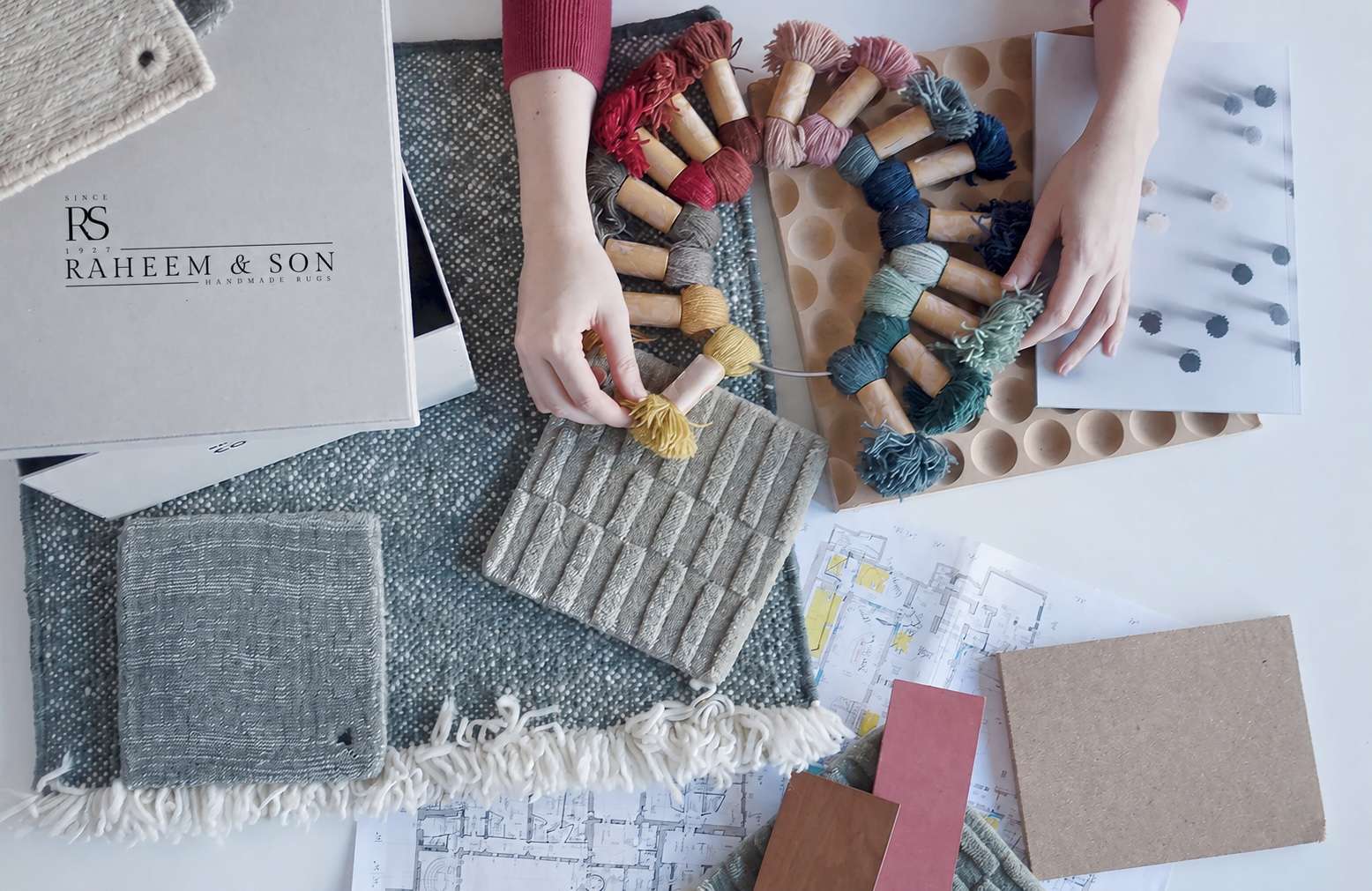
Never place a production order without an approved sample. A quality supplier will produce a hand-made strike-off, a small section of the rug at full construction specification, before production begins. The strike-off lets you approve pile height, colour, and knot density before any significant weaving time is committed.
Colour approval is the most common friction point. Dyed wool is subject to lot variation: the same dyestuff at the same concentration can produce slightly different results between dye runs because of water pH, temperature, and fibre variation. Set colour tolerance in writing, the industry standard is a visual assessment against the approved standard under D65 (daylight equivalent) lighting. If you use a spectrophotometer in your quality lab, specify the dE00 tolerance you will accept.
Strike-off lead times in Bhadohi are typically two to four weeks. Once approved, production lead times for hand-knotted pieces depend heavily on knot count. A lower-knot-count piece at 80 KPSI might achieve 0.6 to 0.8 m² per loom per week. At 200+ KPSI (Persian-style quality), output drops significantly. Build these constraints into your delivery planning.
Quality control during production
Third-party inspection is standard practice for import buyers. Agencies such as QIMA, Bureau Veritas, and SGS operate in the Bhadohi region and can conduct mid-production and pre-shipment inspections. For a first order with a new supplier, a mid-production check, typically at 30 to 40% completion, lets you catch problems before the order is finished.
Standard inspection criteria for hand-knotted rugs include: pile height variation (front-to-back and edge-to-centre), knot count verification, dimensional accuracy, colour consistency against approved standard, fringe and edge condition, and pile direction uniformity. Include your specification in the inspection brief, do not leave it to the agency's default checklist.
For hospitality programmes, request a composition test certificate. A REACH-compliant certificate of analysis from an accredited European laboratory will confirm fibre content and confirm the absence of restricted substances. Many buyers require this for product liability documentation.
Landed-cost planning
FOB price is only the start. Freight, insurance, import duty, customs brokerage, and last-mile delivery all affect your true landed cost. Sea freight from Nhava Sheva (Mumbai) to Hamburg runs approximately [18 to 24 days] transit. Freight rates fluctuate with container demand; get current quotes from your forwarder before building a margin model.
Import duty in the European Union for hand-knotted rugs (HS 5701.10) is currently [x]%, check the EU TARIC database for the current bound rate and any applicable anti-dumping or safeguard measures. Your customs broker should advise on classification. In the United States, the duty rate under the HTS code applicable to Indian hand-knotted rugs should be confirmed with your customs attorney, as country-of-origin rules and Section 301 dynamics may apply.
Working with an experienced freight forwarder who knows the Bhadohi-to-destination lane is worth the additional coordination effort. They will know which shipping lines have reliable sailing schedules from Nhava Sheva, what seasonal surcharges to budget for, and how to handle documentation for natural-fibre goods that may require phytosanitary certificates.