Extra Seating Without Extra Furniture
Living with it · 19 February 2026 · 5 min · Published by Raheem & Son for RS Living
A room that seats four most nights and eight twice a year does not need eight chairs. What poufs actually solve, which materials suit which use, and how to store them.
The problem with buying chairs for the busiest night
Most sitting rooms are furnished for their peak. Eight people come at Diwali or at Christmas, so eight seats are bought, and for the other three hundred and sixty days the room is crowded with furniture nobody sits on.
Poufs invert that. They seat one person each when needed, stack against a wall when not, and weigh little enough that a child can move them.
They also do three other jobs a chair cannot: footstool, side table under a tray, and the thing a guest puts a bag on.
Which material for which use
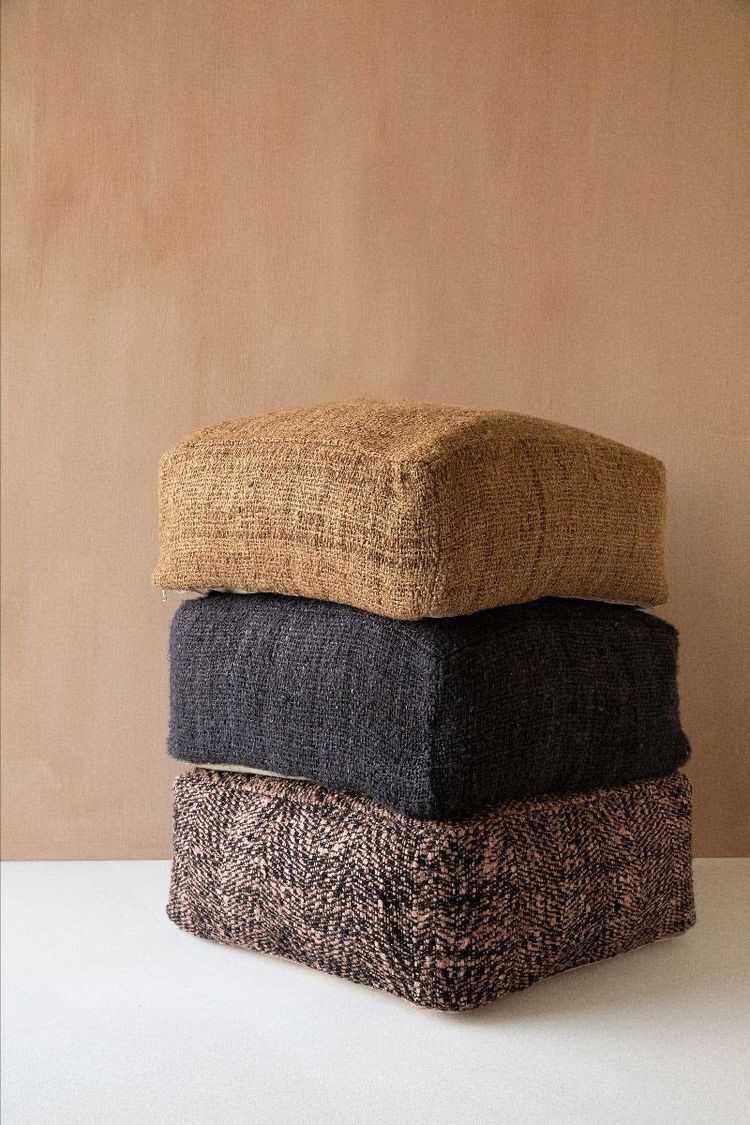
The stack in the picture is three different materials, and the difference is not decorative.
Jute and hemp. Firm, coarse, hard-wearing, and the most upright of the three. Best where a pouf is genuinely used as a seat, because it holds its shape under weight. Not the one to choose for bare legs in shorts.
Wool. Softer under the hand, warmer, and the most forgiving of the three on colour, because wool takes dye deeply and hides marks. The best all-round choice for a family sitting room.
Leather. The most durable and the one that improves with age, developing the patina a wool pouf never will. Heavier, more expensive, and the right choice where it will be used daily for years rather than occasionally.
All three are filled after they arrive in most cases, which matters for shipping. Ask what filling is recommended: cotton offcuts pack firm and stay firm, polystyrene beads are lighter and settle within a year.
Sizing and how many
A square pouf at 50 by 50 by 40cm tall seats an adult comfortably. Below about 35cm tall it becomes a footstool rather than a seat, whatever the description says.
Round poufs of 45 to 60cm diameter suit footstool duty and reading corners. Square and rectangular shapes stack better and store flatter.
Two is the useful minimum, because one pouf is a footstool and two are seating. Four in a small flat covers most occasions without a single extra chair.
Storing them so they still look good in year three
Stack them, do not squash them. A stack of three is stable and takes the footprint of one.
Keep them out of a sunny window when stored. A pouf that lives in a bright corner for two years fades on one face only, and that is the face you will notice.
Rotate which one is on top. The top of a stack takes the dust and the bottom takes the compression, so swapping them twice a year evens out both.
Brush rather than vacuum jute, which sheds if you take a beater bar to it. Wool poufs take a gentle vacuum with the head only.
Questions
Are poufs comfortable enough to sit on?
A firm pouf at least 40cm tall seats an adult comfortably for an evening. Below about 35cm it works as a footstool rather than a seat.
Which pouf material is most hard-wearing?
Leather lasts longest and improves with age. Jute is the firmest and holds its shape best under weight. Wool is the most comfortable and the most forgiving of marks.
How many poufs does a small living room need?
Two as a minimum, because one reads as a footstool and two read as seating. Four covers most occasions in a flat without adding a single chair.
Do poufs arrive filled?
Often not, because filling is bulky to ship. Ask before ordering. Cotton offcuts pack firm and stay firm, while bead fillings are lighter and settle over the first year.