Working With Green at Home: Olive, Moss and Sage
Colour · 8 April 2026 · 6 min · Published by Raheem & Son for RS Living
Green is the easiest strong colour to live with and the hardest to buy online, because it shifts more between one light and another than any other hue. How to choose it and what to put beside it.
Why green is the hardest colour to buy on a screen
Green sits in the middle of the visible spectrum, where the human eye is most sensitive, which is exactly why we discriminate between greens more finely than between any other family of colours. You will notice a shift in a green that you would never see in a navy.
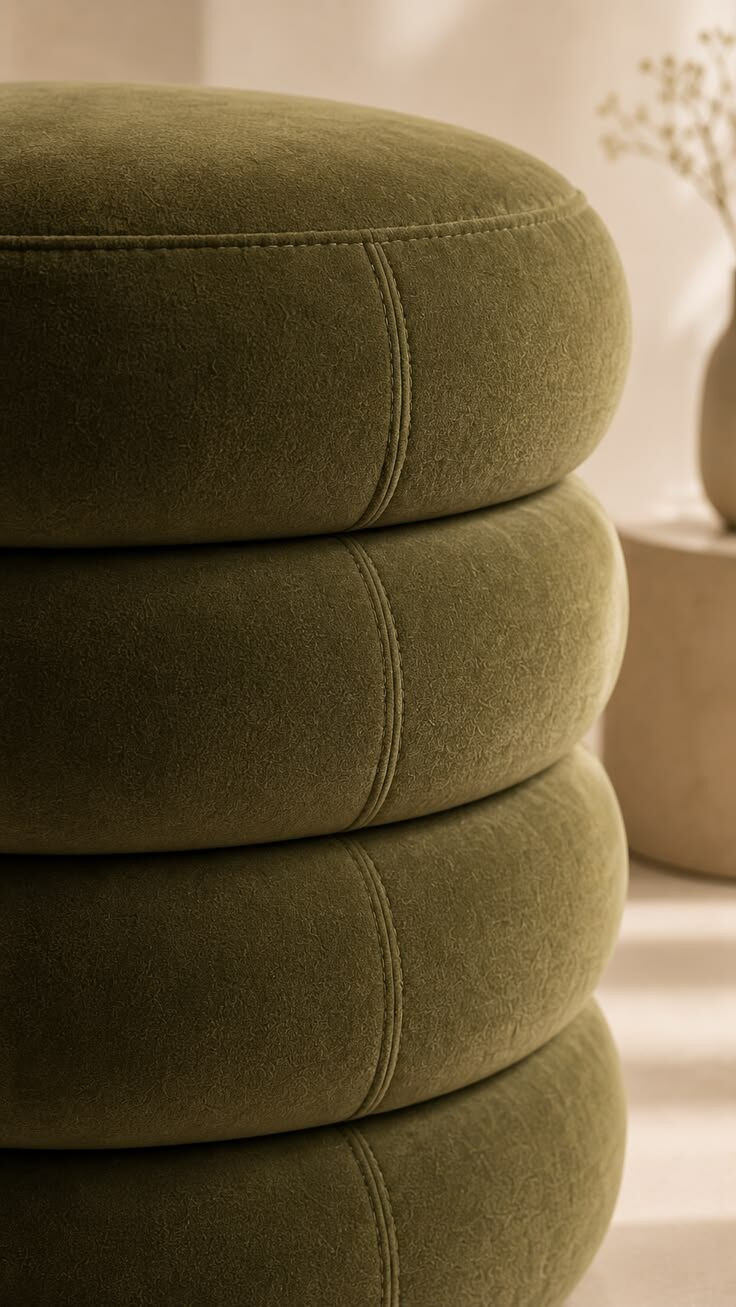
It is also the colour most affected by the light in the room. A warm 2700K bulb pushes an olive toward brown and a sage toward grey. North daylight pulls both toward blue. The same pouf genuinely looks like two different objects at noon and at nine in the evening.
So of all the colours in the store, green is the one where a sample is not a nicety. Look at it on your own floor, in daylight and again under your own lamps, before committing.
The three greens, and what each one does
Olive. Yellow-leaning and warm, the most forgiving of the three. It behaves like a neutral against wood, leather and cream, and it is the green that reads as expensive rather than as a colour choice. The safest starting point in a room with warm light.
Moss. Deeper, greyer, closer to black in low light. It gives weight to a room the way a charcoal does, without the hardness. Best in a room with good daylight, because in a dark room it simply reads as very dark.
Sage. Pale, grey-leaning and cool. It recedes, which makes it useful in a small room, and it is the only one of the three that will fight with warm bulbs. Sage in a room lit at 2700K goes flat and slightly dirty. If you love sage, use cooler lamps.
What to put beside it
Green's natural partners are the materials it grows next to. Undyed wool, jute, unfinished oak, terracotta, clay plaster, unglazed ceramic. Anything with a matte, slightly irregular surface.
It sits well against warm neutrals and rust. Olive and terracotta is one of the most reliable pairings there is, because they are close to complementary without the harshness of true green and red.
It fights with cool grey, with anything blue-leaning white, and with high-gloss surfaces. A sage cushion against a cool grey sofa makes both look faded.
For a floor beneath it, an undyed or lightly dyed wool rug is the quiet answer. If you want the rug to carry the green instead, keep the furniture neutral and let one thing be green rather than three.
Living with it over time
Green dyes, particularly the yellow-leaning olives, are among the more light-sensitive. A green piece in a sunny window will shift toward grey-brown over several years. Rotate anything green twice a year, and keep it out of a direct beam if you can.
Because our yarn is dyed in batches at Bhadohi rather than run continuously, a green ordered next year will be close to but not identical to one ordered today. If you plan to add a matching piece later, order both together or ask us to hold yarn from the same lot.
This is also the argument for choosing green in wool rather than in a fibre with more sheen. Wool's matte surface hides the small colour shifts that a lustrous fibre broadcasts.
Questions
Which green works best in a room with warm lighting?
Olive. It is yellow-leaning, so warm bulbs deepen it rather than dulling it. Sage is the one to avoid under warm light, because it goes flat and slightly dirty.
What colours go with olive green?
Terracotta, rust, undyed wool, jute, oak and clay. Olive behaves like a warm neutral. It struggles against cool grey and blue-leaning whites.
Does green fade faster than other colours?
Yellow-leaning greens are among the more light-sensitive dyes and shift toward grey-brown over years of direct sun. Rotate the piece twice a year and keep it out of a direct beam.
Will a green piece ordered later match one I own?
It will be close, not identical, because yarn is dyed in batches. If you plan to add a matching piece, order both together or ask us to reserve yarn from the same lot.