Hanging a Rug on the Wall
Living with it · 24 June 2026 · 5 min · Published by Raheem & Son for RS Living
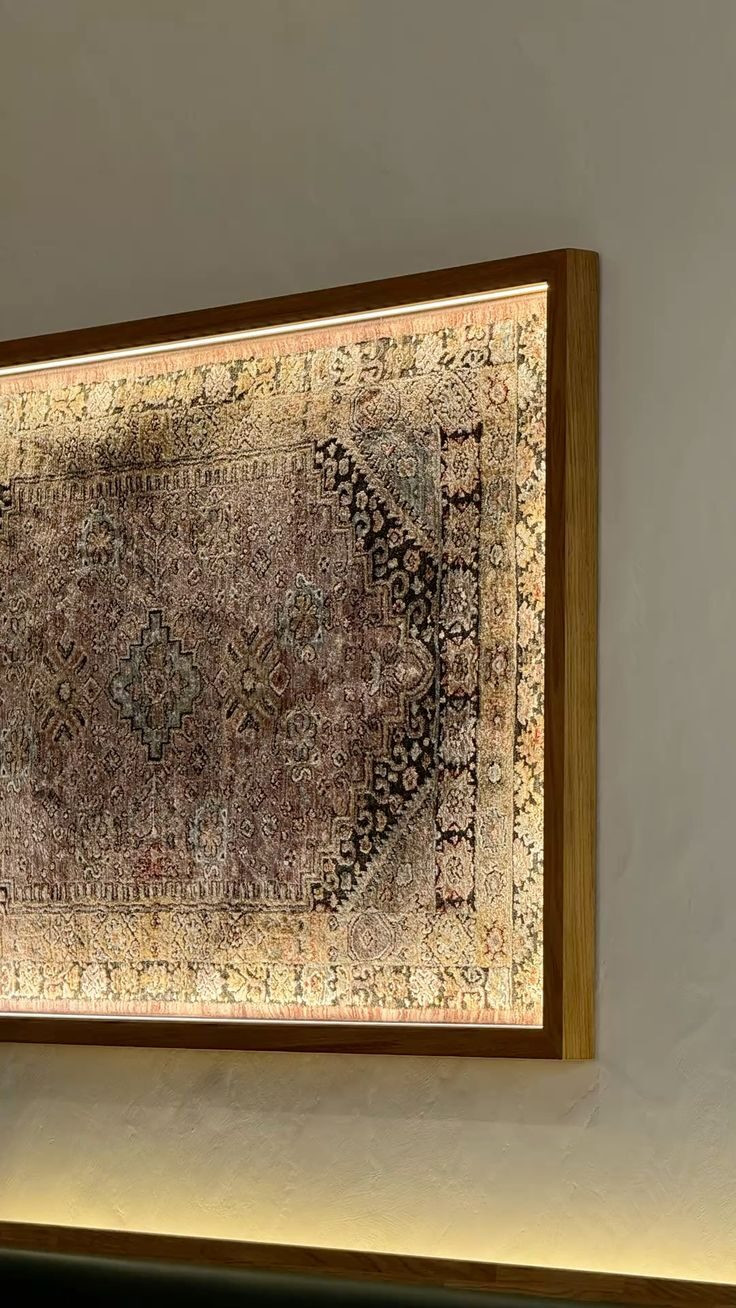
A rug on a wall is the oldest way of displaying one and it asks different things of the rug than a floor does. Which pieces suit it, how to take the weight, and what ruins a rug hung badly.
Why a wall, and which rugs belong on one
Hanging textiles is older than framing pictures. A rug on a wall does two things a painting cannot: it absorbs sound, noticeably, and it puts a large field of texture at eye level where you actually read it.
The pieces that suit it are the light ones and the detailed ones. Flatweaves, kilims, fine low-pile hand-knotted rugs and anything whose pattern rewards being looked at closely. A thick hand-tufted rug is the wrong candidate: it is heavy, it hangs stiffly, and its pattern is usually designed to be read from above at a distance.
Weight is the whole engineering problem. A flatweave might be two kilos per square metre. A dense hand-knotted piece can be four times that.
Spread the load, always
The single rule that matters: never hang a rug from a few points. Two nails through the top corners will tear the foundation within a year, because the entire mass of the rug is concentrated on a handful of threads.
The load has to be carried evenly across the whole top edge. There are two good ways to do that.
A sleeve. Stitch a fabric tube along the back of the top edge, using cotton twill tape and a loose hand stitch through the foundation rather than through the pile. Slide a wooden batten or a metal rod through the sleeve and rest that on brackets. This is the museum method and it is the kindest to the rug, because nothing is fixed permanently to the textile.
Velcro. Stitch the soft loop side of a velcro strip to a length of twill tape, hand stitch that tape along the top edge, and staple the hook side to a batten fixed to the wall. Slightly quicker, equally well distributed, and it lets you lift the rug off in a second.
The things that quietly ruin a hung rug
Direct sunlight. A rug on a floor gets walked over and rotated. A rug on a wall sits in the same beam of light every afternoon for years and fades in a hard-edged band. Hang it on a wall the sun does not cross, or accept that it will change.
Never rotating it. Take it down once a year, turn it end for end and rehang it. It evens out both the fading and the stretch.
Adhesive. Never glue a rug to anything, and never staple through the pile. Both are irreversible and both destroy the value of a good piece.
Damp. An outside wall in an unheated room will hold moisture against the back of the rug. Batten it off the wall by a centimetre so air can move behind it.
Scale and placement
Treat it as one large artwork rather than as a rug that happens to be vertical. It wants a wall it can dominate, and it wants breathing room on both sides.
Hung above a sofa, keep the bottom edge about twenty to twenty-five centimetres above the back, and let the rug run to roughly two thirds to three quarters of the sofa's width. Hung on its own, centre it on the wall rather than on the furniture.
A small rug on a large wall reads as a mistake. If the piece is small, hang it low and pair it with something, or put it on the floor where it belongs.
Questions
Will hanging a rug damage it?
Not if the weight is spread across the whole top edge with a sleeve or a velcro strip. It will be damaged by hanging from a few nails, by glue, by staples through the pile, and by years of direct sun.
Which rugs are best for hanging?
Light, detailed and flat. Flatweaves, kilims and fine low-pile hand-knotted pieces. Thick hand-tufted rugs are too heavy and too coarse to read well at eye level.
Does a rug on the wall help with sound?
Yes, meaningfully. A large textile on a hard wall cuts reflection and takes the hardness out of a room with stone or timber floors.