Inspect during production, not at the end of it
The instinct is to inspect the finished goods before they ship. By then every fault is expensive: the rug is woven, washed, finished and packed, and the only remedies left are to accept it, discount it, or reweave it and miss the date.
On handmade goods the inspections that actually save money happen earlier. There are four useful points, and a serious programme uses at least three of them.
At strike-off, before production begins, you approve construction and colour against the standard. At first-off, when the first piece of a run comes off the loom, you confirm the approved specification survived the transition from sample to production. During weaving, at roughly the halfway point on long-lead pieces, you catch drift before half the order is affected. And at pre-shipment, you verify the finished goods and the packing.
Catching a colour drift at first-off costs one rug. Catching it at pre-shipment costs the order.
What to check, and against what
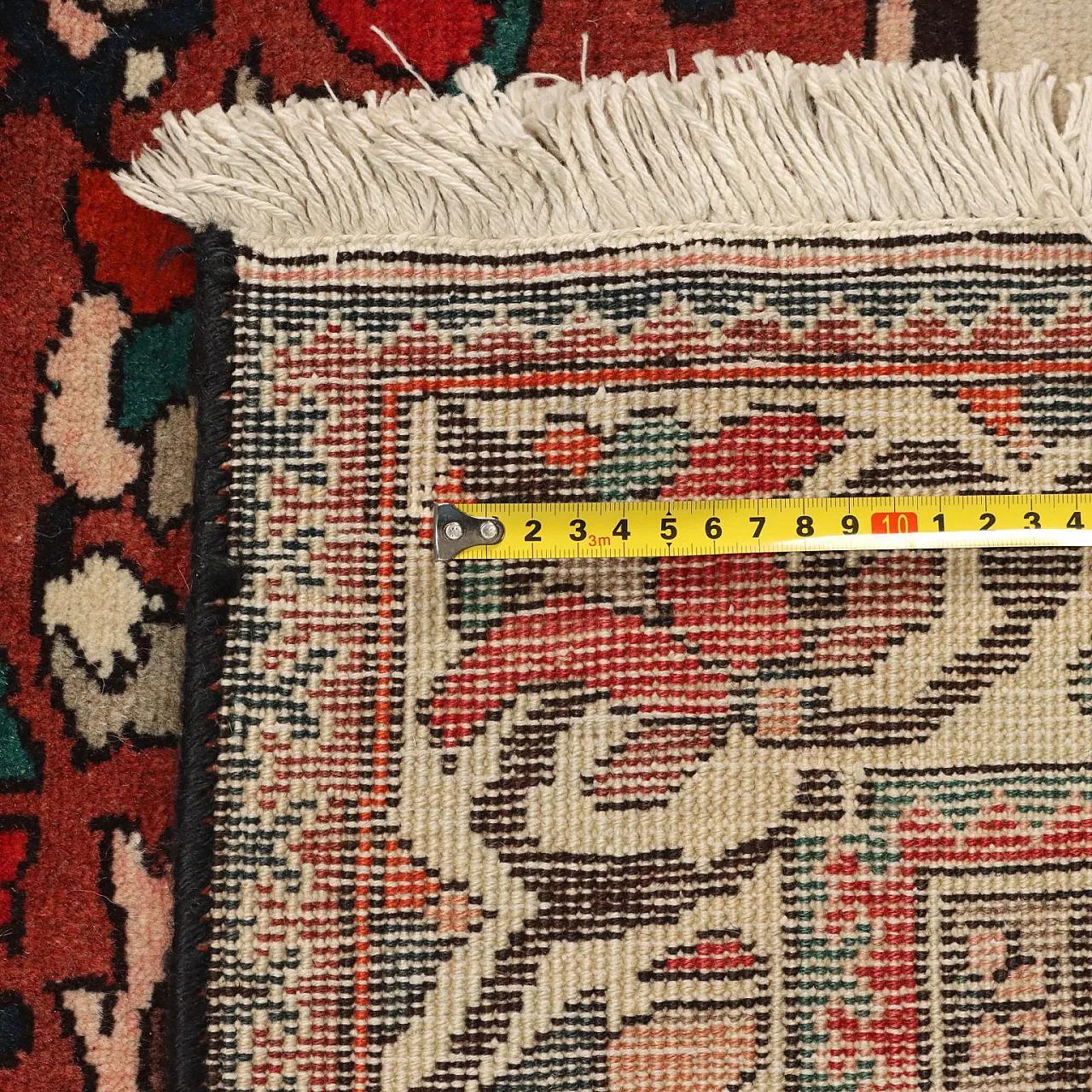
Dimensions. Measure length and width at three points each, and both diagonals to check square. Handmade rugs relax off the loom and move again in the wash, so specify a tolerance rather than a single number. One to two per cent per dimension is the normal working range for hand-knotted and hand-tufted pieces. Where a rug fits a fixed opening, specify the opening and the direction the tolerance may run.
Colour. Assess against the approved standard under controlled light, D65 daylight-equivalent, not under whatever lamp the warehouse has. Check for metamerism by viewing under a second illuminant: two samples that match under daylight and diverge under tungsten will diverge on site. If your quality function uses instruments, specify the tolerance as a dE00 figure so it is unambiguous.
Construction. Knot or tuft density measured over a stated area, pile height at several points, total weight against the specified grams per square metre. Weight is the most useful single number, because it is hard to hit while quietly reducing density.
Finish. Selvedge and binding integrity, fringe attachment where specified, backing adhesion on tufted pieces, shearing evenness, and the absence of pile distortion from handling.
Wash and dry. Check the reverse for water marks and for any smell of damp. A rug packed before it is fully dry will arrive mildewed after five weeks in a container, and this is one of the few faults that can destroy an entire shipment.
How AQL applies to handmade goods, and where it does not
AQL sampling, defined in ISO 2859-1, is designed for manufactured goods where units are close to identical. Handmade rugs are not identical by definition, so the framework needs adapting rather than importing wholesale.
Where it works well is on large runs of the same design and size. Draw the sample size the standard prescribes for the lot, and set separate acceptance numbers for critical, major and minor defects. A workable starting point for contract rug programmes is zero critical defects, AQL 2.5 for major, AQL 4.0 for minor, though the right numbers depend on the end use and should be agreed before production.
Where it breaks down is on small runs of bespoke pieces. If a hotel programme includes six unique lobby rugs, statistical sampling is meaningless: inspect all six, one hundred per cent.
The critical work is defining the defect classes in writing, in advance, and both parties signing them. A critical defect is one that makes the rug unusable or unsafe: a hole, a tear, a structural fault, the wrong dimension beyond tolerance, the wrong specification. A major defect is visible at normal viewing distance and would be noticed by a guest. A minor defect is visible only on close inspection. Without that written definition, every inspection becomes an argument about whether something counts.
Variation is not a defect, and the line has to be written down
The most common dispute on handmade goods is not about faults, it is about variation being reported as a fault by an inspector trained on machine-made product.
Abrash, the soft banding across a pile where the weaver moved between dye lots, is a property of hand-dyed yarn. Slight irregularity in a hand-drawn pattern edge is a property of hand weaving. A pile that reads lighter from one direction is a property of every cut-pile rug ever made. None of these is a defect, and an inspection protocol that does not say so will generate rejections that cost weeks and change nothing.
Write the acceptable variation into the specification with the same care as the tolerances. Name abrash explicitly. State the dimensional tolerance. State that pile direction affects apparent shade. Then, separately and just as clearly, state what is not acceptable, so nobody can use variation as cover for poor work.
Third-party inspection and who pays
For a first order with a new supplier, or for any programme where the cost of failure is high, book an independent inspection agency. The established firms all operate in the Indian rug clusters and will inspect against a protocol you provide.
Give the inspector the protocol, the approved standards and the defect classifications in advance. An inspector working without them will apply generic textile criteria that do not fit handmade rugs, and the report will not be useful.
Inspection is normally at the buyer's cost, and it is cheap against the value it protects. Where a shipment is rejected and reworked, the cost of the re-inspection is usually the supplier's, and that should be stated in the purchase terms rather than negotiated after the fact.
Ask for photographs in the report, and ask for them to include a scale reference and a note of the lighting used. A photograph of a colour deviation taken under a warehouse sodium lamp proves nothing.