Lighting a Reading Corner
Light · 23 May 2026 · 5 min · Published by Raheem & Son for RS Living
A chair, a light and a rug is the smallest complete room there is. The heights and angles that make it work, and why a swing-arm beats a floor lamp in a small space.
The smallest complete room
A chair, a light, a small rug and a surface to put a cup on. That is a reading corner, and it can be assembled in a bay window, at the end of a bedroom or in the dead corner of a sitting room that nothing else fits into.
It works because it is defined. The rug draws the boundary, the light draws the ceiling down, and inside that boundary the corner reads as its own place rather than as leftover floor.
A rug of roughly 120 by 180cm, or a 150cm round, is usually enough. It should sit fully under the chair with room for both feet in front of it.
Get the light behind your shoulder
The light should come over one shoulder from behind, not from in front and not from directly above.
From in front, the page glares and your own shadow falls on the book. From above, the shadow of your head lands exactly where you are trying to read.
The bottom of the shade should sit at roughly the height of your shoulder when seated, which is around 100 to 110cm from the floor for most people in most chairs. Sit in the chair with a book before you fix anything to a wall.
For reading, aim for around 400 to 500 lumens reaching the page. In practice that is a single 6 to 8 watt LED in a shade close to the book, not a bright bulb far away.
Why a swing-arm wall light wins in a small space
A floor lamp needs floor. In a small room that is exactly the thing you do not have, and its base competes with the chair and the rug.
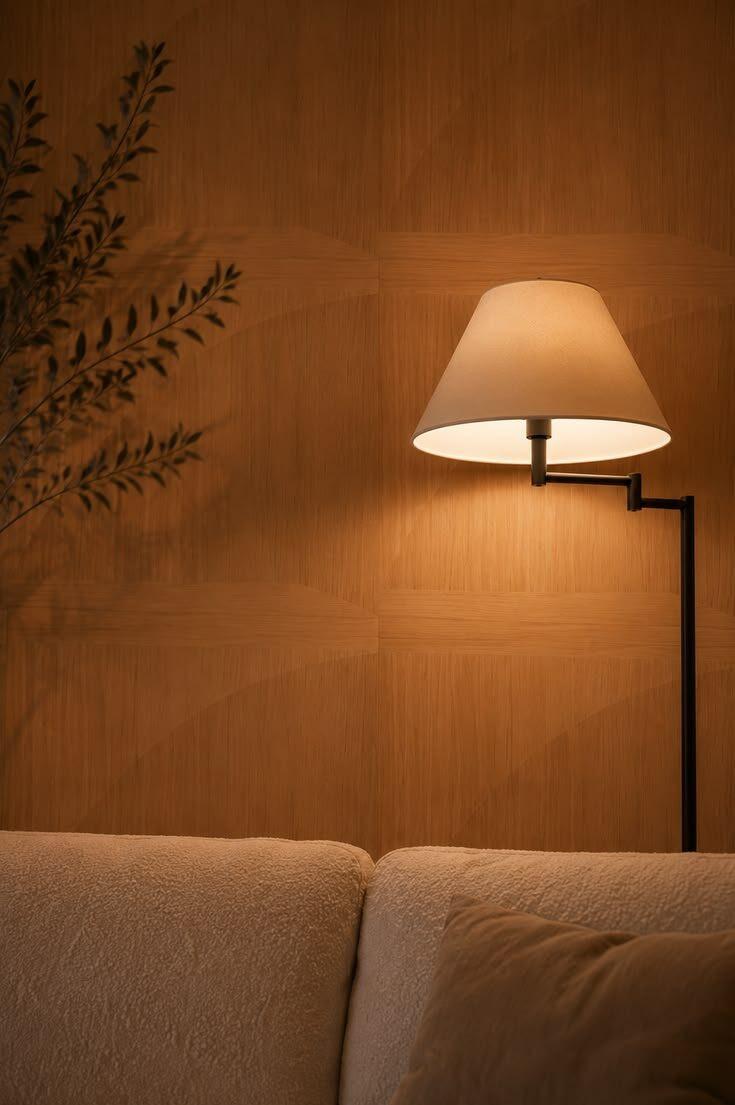
A swing-arm mounted on the wall, as in the picture above, gives back the floor entirely. It also adjusts: you pull it in over the page to read and push it back against the wall the rest of the time.
Fix it at roughly 120 to 140cm from the floor to the mounting plate, which puts the shade at shoulder height once the arm is extended.
The one drawback is that it needs a wall and, ideally, a socket or a spur. In a rented flat a plug-in swing-arm with a cord cover is the honest compromise.
Finishing the corner
Warm light, 2700K, CRI 90 or above. A reading corner is used after dark and warm light is what makes it feel like one.
A dimmer, or at least a two-stage bulb. Reading wants more light than sitting.
A small rug with some texture. This is a corner you will sit in barefoot, so it is the one place a slightly deeper pile earns its keep, unlike a hallway or under a dining table.
Something at eye level on the wall. A hung textile, a small picture, a shelf. A corner with nothing above the chair feels unfinished no matter how good the light is.
Questions
Where should a reading light be positioned?
Over one shoulder from behind, with the bottom of the shade at seated shoulder height, roughly 100 to 110cm from the floor. Light from in front glares and light from above casts your own shadow on the page.
How bright should a reading light be?
Around 400 to 500 lumens reaching the page, which is a 6 to 8 watt LED in a shade close to the book rather than a bright bulb further away.
What height should a swing-arm wall lamp be mounted at?
Roughly 120 to 140cm from the floor to the mounting plate, which puts the shade at shoulder height once the arm is extended.
What size rug suits a reading corner?
About 120 by 180cm, or a 150cm round. It should sit fully under the chair with room for both feet in front.