The Specific Challenge of the Dining Room
The dining room rug faces a combination of demands that no other residential rug position imposes with the same intensity. Chairs are pulled back and pushed forward repeatedly throughout every meal. Food and liquid reach the floor with some regularity. The rug must lie flat enough for chair legs to glide without catching. And despite all this, it must look considered and beautiful in a room that is often the most formal in the home.
This combination of practical and aesthetic demands means that the selection criteria for a dining room rug are more constrained than for a bedroom or sitting room piece. The range of suitable constructions and materials is narrower. Getting the specification right from the start saves significant frustration over the years.
The good news is that within those constraints, there are still genuinely beautiful options. A well-chosen dining room rug that handles the practicalities with ease and looks elegant while doing so is entirely achievable.
Size: The Most Critical Decision for Under a Table
The sizing rule for dining room rugs is more specific than for other positions in the home, and it is important to understand it before measuring. The rug must extend far enough beyond the edges of the table that chairs remain fully on the rug when pulled back for a person to be seated. A chair leg that catches the rug edge is both a practical nuisance and a source of long-term wear at the rug's perimeter.
The recommended extension beyond the table edge on each side is a minimum of sixty centimetres. For a standard rectangular table seating six to eight people, this typically requires a rug of around 240cm x 300cm or larger, depending on the table dimensions. For a round table, the same sixty centimetre extension applies in all directions, usually producing a requirement for a round or large square rug.
It is worth measuring this carefully and verifying the dimensions with physical tape in the room before ordering. The cost of a rug that is too small in a dining room context is disproportionate because the problem becomes apparent on the very first occasion the room is used. Our size and fitting guide includes specific dining room calculations.
Pile: Why Lower Is Better Here
Pile height is one area where the dining room has clear requirements. A high pile rug under a dining table creates several problems. Chair legs sink into a deep pile, making them harder to pull back. The pile surface around the chairs flattens into visible traffic lanes quickly. And a deep pile traps food debris and liquid more readily than a flatter surface.
A low to medium pile, or a flat-woven construction, performs better in dining room conditions in every practical respect. The chair legs glide smoothly on a flatter surface. Cleaning is more straightforward. Traffic lanes are less visible. And the visual character of a low pile or flatweave is often more suited to the formal quality of a dining room than a deep, shaggy pile would be.
Medium pile rugs can work in dining rooms where the construction is dense and the wool quality is high, but the pile should be on the lower end of the medium range and the density should be sufficient to prevent visible flattening around the chairs over time.
Material: Wool, Flatweave and Natural Fibre Options
Wool remains the best natural fibre for a dining room rug in most circumstances. Its natural lanolin makes it somewhat resistant to liquid absorption, giving a brief window for blotting before a spill penetrates to the foundation. Its resilience means it recovers from chair leg compression better than most alternatives. And it responds well to professional cleaning when a deeper clean is needed.
Flatweave constructions in wool or cotton are an excellent choice for formal dining rooms. A dhurrie, kilim, or woven flatweave has no pile to trap debris, lies completely flat for chair movement, and can be professionally cleaned with ease. The aesthetic of a fine flatweave suits a formal dining context well, and the pattern range available in flatweave constructions is extensive.
Natural fibre rugs in jute or sisal are sometimes chosen for dining rooms because of their textural quality and their durability under foot traffic. They are robust, but they do not handle liquid well and should not be used in dining rooms where spills are a realistic probability. Their texture also makes spot cleaning more difficult than with a smooth wool or cotton surface.
Pattern and Colour: Hiding the Inevitable
Colour and pattern choice in the dining room should be informed partly by practical considerations. A mid-toned palette with some pattern or textural variation is more forgiving of the inevitable small marks and spills than a pale, solid surface. This does not mean the rug should be dark or busy, but it does mean that a very pale, very plain rug requires more vigilance in a dining context than the same rug in a bedroom.
Tonal patterns, geometric repeats, and traditional designs with varied colouring are all good choices for dining rooms. They provide enough visual interest to make the room feel considered while distributing the eye across the surface rather than concentrating attention on any one area, which means small imperfections are less conspicuous.
Pale, monochromatic rugs can work in dining rooms where the household is careful and children are not present, but they are genuinely more demanding to maintain and should be chosen with clear eyes about the cleaning commitment involved.
Cleaning and Maintenance for Dining Room Rugs
Prompt attention to spills is more important in a dining room than anywhere else in the home. Blot, do not rub, and work from the outside of a spill inward to prevent spreading. Wine, oil, and sauces should be addressed immediately. A small amount of clean, cool water applied to the blotted area and then blotted again is usually the safest immediate treatment.
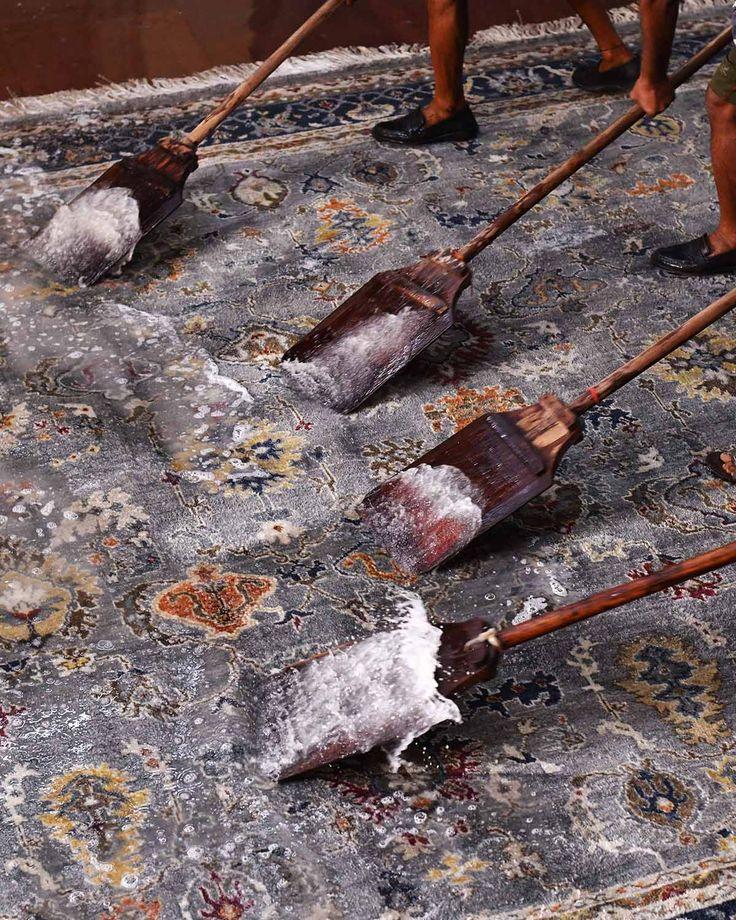
For a dining room rug that sees regular use, professional cleaning every one to two years is more appropriate than the two to three year schedule that suffices for a lightly used bedroom rug. The nature of the dining environment means the rug accumulates a level of embedded soil that routine vacuuming cannot address.
Our care and cleaning guide includes specific advice for dining room rugs, including guidance on dealing with specific stain types and when to call a professional rather than attempting home treatment.
Making the Right Choice for Your Dining Room
The dining room rug selection narrows fairly quickly once the size is correctly calculated and the pile height requirement is understood. Within those parameters, the decision becomes one of aesthetic preference: the mood and palette of the room, the level of formality desired, and the design language of the furniture and other surfaces.
Buyers who would like to request samples or discuss their dining room context with our team can contact us through our personal curation service. Seeing an actual sample in your room, at the table, in your dining room's light, will tell you more than any amount of online browsing.
Frequently asked
How large should a rug be under a dining table?
The rug should extend at least sixty centimetres beyond the table edge on all sides so that chairs remain fully on the rug when pulled back. Measure your table and add at least 120cm to both the length and width to arrive at the minimum rug dimension.
What is the best rug material for a dining room?
Wool is the most practical natural fibre for dining rooms. It resists liquid absorption briefly, handles foot traffic well, and responds well to professional cleaning. Flatweave constructions in wool or cotton are also excellent choices for their ease of cleaning and flat surface.
Can I use a high pile rug in a dining room?
We do not recommend a deep pile rug for a dining room. High pile creates difficulty pulling chairs back, flattens unevenly under chair legs, and traps food debris. A low to medium pile or a flatweave construction performs significantly better in this context.
How do I clean a spill on a dining room rug?
Blot immediately with a clean cloth, working from the outside of the spill inward. Do not rub. Apply a small amount of cool water if needed and blot again. For oil or wine, contact a professional cleaner promptly if the initial blotting does not address the mark. Our care guide has specific guidance for common dining spill types.
By RS, 4 December 2025
More in Interiors and Styling.
Follow the journal in Google Search. Readers who add us as a preferred source see our writing marked in Top Stories and in AI Overviews.