Why Washing Is Not Just Cleaning
In textile production generally, washing is understood as cleaning: the removal of soiling, residues, and contaminants. For a hand-knotted rug, washing has this function but also serves several others that are integral to the rug's final character. The wash relaxes fibres that have been under tension at the loom for weeks or months. It sets the dyes, stabilising the colour and evening out any variation introduced by the dyeing process. It softens the pile, opening the fibres and giving the rug the characteristic handle that distinguishes a finished handmade piece from the same rug taken directly off the loom.
The difference between a washed and an unwashed hand-knotted rug is immediately apparent to anyone who handles both. The unwashed rug is stiff, slightly harsh, and the colours appear flat or unresolved. After washing and drying, the same rug becomes supple, the pile opens and has body, and the colours read with the depth and warmth that the dye intended but could not fully express before relaxation.
Washing is therefore the step at which the rug's final character is established. It is performed by specialists who understand how different fibres and dye types respond to water, alkalinity, mechanical action, and drying conditions. A poorly executed wash can damage pile, distort the rug's shape, strip dyes unevenly, or cause differential shrinkage in warp and weft. A well-executed wash delivers a rug whose colour, handle, and form are precisely what the producer and the buyer expect.
The Washing Environment and What It Requires
Traditional rug washing is carried out outdoors or in large open facilities near water sources. Bhadohi and its surrounding region, where many of our rugs are made, has long been home to specialised rug washers who have developed their practice over generations. The combination of appropriate water quality, outdoor space for flat drying, and accumulated expertise is difficult to replicate in an indoor industrial setting.
Water quality matters considerably. Hardwater with high mineral content can interact with natural dyes and wool fibres in ways that affect colour. Some washing facilities use softened water; others use water sourced from rivers with specific mineral profiles that have been found through experience to produce good results with the fibre and dye types in local production. This is knowledge that does not appear in technical specifications but is embedded in the practice of the skilled washer.
The temperature and duration of the wash are calibrated to the rug's fibre composition and the dye types used. Silk requires cooler water than wool and less mechanical action. Natural dyes generally require more careful handling than synthetic dyes, though this varies by dye source and mordant. A professional washer assesses each rug individually rather than applying a uniform programme.
Washing Techniques: From Gentle Hand Methods to Mechanical Assistance
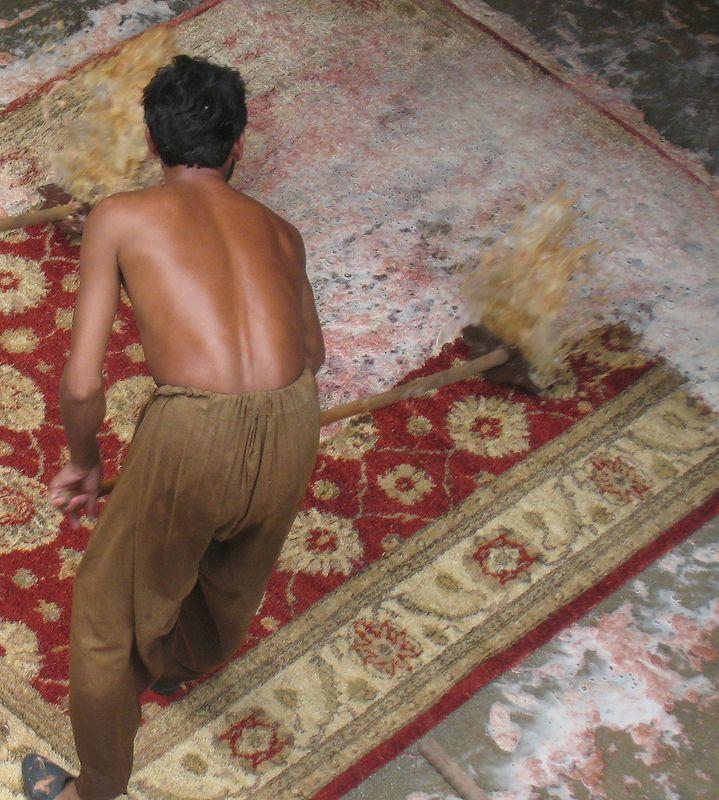
The gentlest rug washing method is by hand: the rug is laid flat on a clean stone or concrete surface, wetted thoroughly, treated with an appropriate cleaning agent, and then scrubbed gently with soft brushes in the direction of the pile. This method provides the most control and is used for particularly fine or delicate rugs, for antique and semi-antique pieces, and for rugs with complex colour compositions where uneven treatment would be immediately visible.
For production volume, partially mechanised methods are common. The rug may be placed on a specialised rack that allows water to circulate through the pile under controlled pressure, or it may be processed through a wash pit where gentle agitation is provided by paddles or rollers. The principle remains the same: sufficient water and cleaning agent to penetrate the pile and dissolve residues, gentle mechanical action to lift and release those residues, and thorough rinsing to remove all cleaning agent before drying.
After washing, excess water is extracted. This may be done by passing the rug through large padded rollers that press water from the pile without distorting the structure, or by hanging the rug vertically for initial drip-drying before laying it flat. The extraction method affects drying time and is particularly important for heavy rugs with dense pile, which can take many hours or days to dry fully.
The Drying Process and Its Effect on Colour
Drying is the step where a rug's colour reaches its final settled state. Wet wool appears darker than dry wool, and as a rug dries, its colour lightens and shifts slightly in tone. An experienced washer knows how a rug's colour will read when dry and can assess whether the wash has achieved the intended result before the drying is complete.
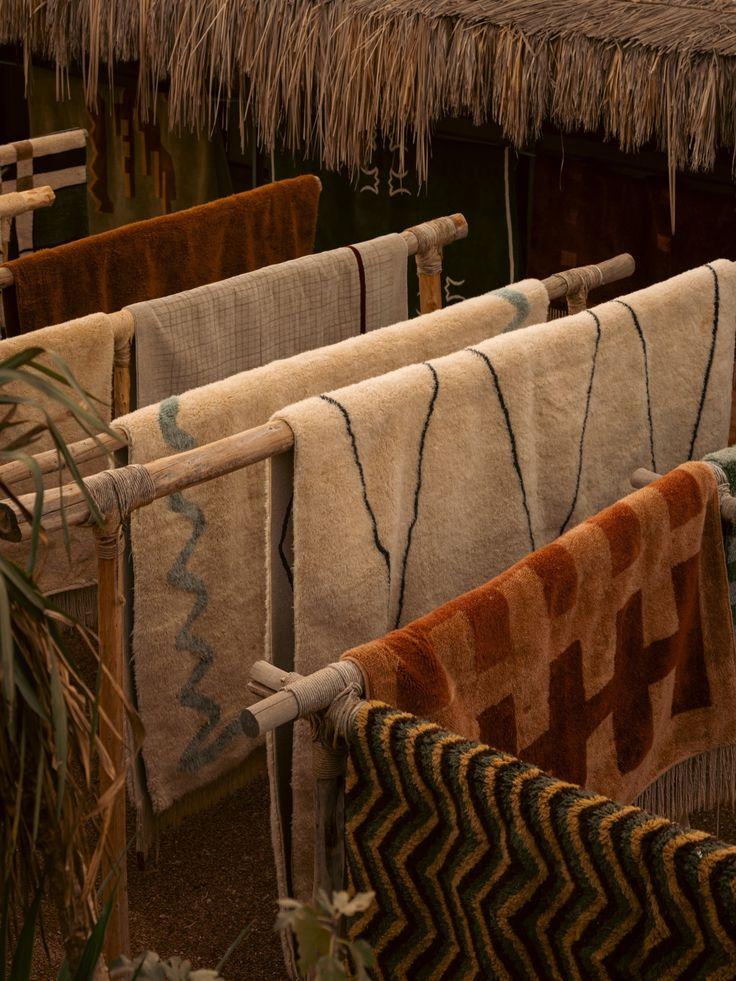
Open-air drying in natural light is the traditional method and remains preferred for most fine rugs. Natural light and air movement dry the pile evenly and without the heat stress that can cause uneven shrinkage or dye migration in mechanical drying. The UV component of natural daylight also has a minor brightening effect on wool and natural dye colours, which is part of why naturally dried rugs tend to have a particular luminosity that is difficult to replicate with mechanical drying.
Our article on open-air drying and rug colour explores the effect of drying conditions on colour in more detail, including how different light exposures during drying affect the final appearance of natural and synthetic dye types.
Quality Inspection After Washing
A quality inspection after washing checks for issues that may have been masked in the dry or semi-finished state. Dye bleeding, where colour from one area has migrated into an adjacent area during the wash, is one of the issues most easily identified at this stage. Minor bleeding can sometimes be corrected by a targeted re-treatment; significant bleeding may indicate a dye stability problem that requires re-dyeing specific areas.
Dimensional inspection after drying confirms that the rug has held its intended shape. Minor distortions can be corrected by stretching while the rug is still slightly damp and securing it in the corrected dimension until fully dry. This is a traditional technique that skilled washers apply routinely. Significant distortion may indicate a structural issue in the weaving that the washing has revealed but cannot fully correct.
Pile condition is also assessed after washing: whether the pile has opened evenly, whether any areas feel harder or stiffer than others, and whether the shearing is consistent across the surface. If inconsistencies are found, localised re-shearing may be required before the rug is approved for dispatch.
What This Means for the Buyer
For a buyer, understanding the washing process contextualises several things about the rug they receive. The slight variation in pile height across a large rug, the way the colour appears slightly different from edge to centre in certain lights, the particular softness of the handle: all of these are outcomes of the washing and finishing process, not imperfections. They are part of what makes a hand-finished rug different from a machine-produced one.
It also means that the care instructions for a hand-knotted rug are designed to preserve the specific state that the finishing process achieved. Washing a fine rug at home with household cleaning products, or through a domestic washing machine, risks undoing the professional wash and introducing unevenness that cannot easily be corrected. For periodic deep cleaning, a specialist rug washer should be used, ideally one familiar with the specific fibre and dye types in the piece.
Our care and cleaning guidance covers domestic maintenance, interim cleaning, and the conditions under which professional washing is appropriate. If you have questions about the specific washing and finishing process used for a rug you have purchased or are considering, contact our team directly.
Frequently asked
How often should a hand-knotted rug be professionally washed?
The frequency depends on use and environment. A residential rug in moderate use might benefit from professional washing every several years. A rug in a high-traffic commercial setting may require more frequent care. Routine vacuuming extends the interval between professional washes.
Can I wash a hand-knotted rug at home?
Routine spot cleaning with a minimal amount of cool water and mild detergent is appropriate for small stains. Full washing at home is not recommended. The risk of dye bleeding, pile distortion, or inadequate drying conditions makes home washing inadvisable for most fine rugs.
Does washing affect the colour of natural dyes?
A properly conducted professional wash should stabilise natural dyes rather than alter them. Improper washing, including excessively hot water, harsh detergents, or strong mechanical action, can strip or shift natural dye colours. This is why specialist rug washers assess each piece individually.
What should I look for in a professional rug washer?
Look for washers who ask about the rug's fibre content, dye type, and construction before quoting. Specialist rug washers who work with fine handmade pieces understand that different materials require different treatment. Avoid generalist carpet cleaning services that apply standard wet extraction methods to all rugs.
By RS, 28 February 2026
More in Materials and Construction.
Follow the journal in Google Search. Readers who add us as a preferred source see our writing marked in Top Stories and in AI Overviews.