
A million knots, tied by hand
A nine-by-twelve Raheem & Son rug can hold more than a million knots. Each one is tied by a single pair of hands, cut with a hook, and pressed into the pile, one gesture, repeated across months. A master weaver at our Bhadohi loom room ties perhaps twelve thousand knots a day. Do the arithmetic and you are looking at almost three months of uninterrupted work on a single piece, before washing, shearing, and finishing even begins.
What does that mean for the object? It means that the rug holds a kind of time that manufactured things simply cannot. Each knot is a decision: the tension of the thread, the angle of the cut, the precise shade of the dyed wool chosen from the bundle hanging beside the loom. There are no undo steps. There is only forward, one knot at a time.
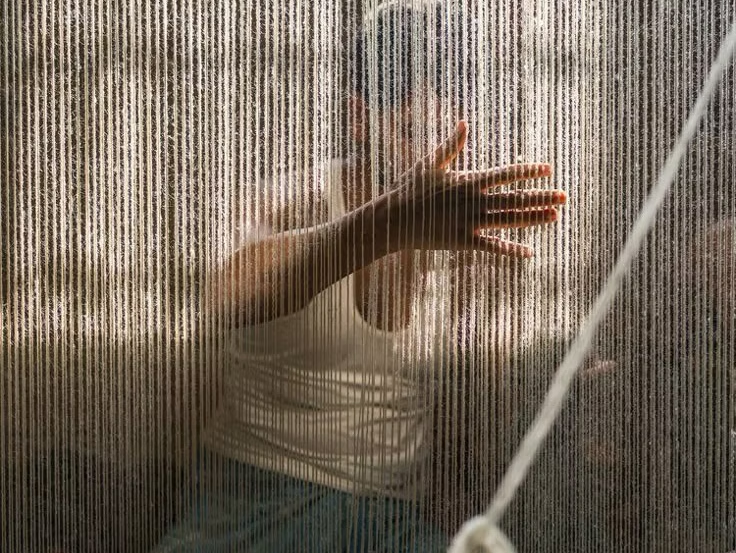
Inside a loom in progress
The photograph above, a weaver seen through the still-warped threads of a loom in progress, captures the strange intimacy of this moment. The warp is taut and vertical; the weaver's hand reaches through it as if through a curtain. In a few months this structure will be entirely invisible, buried inside a rug that will live on a floor for a generation or more.
Why we show the making
We show these photographs not as a marketing exercise but because we think the making deserves to be seen. When you stand on a hand-knotted rug, you are standing on a record of someone's sustained attention. That seems worth knowing.
Read the full guide
Read the full guide: The Ancient Method of Hand-Knotting, Explained sets out how a hand-knotted rug is made, step by step.
By Raheem & Son Editorial Desk, 18 April 2026
Written with the production and export teams in Bhadohi, where Raheem & Son has made rugs since 1927. See about the house and how we manufacture. Read our editorial policy.
Part of: Rug education: weave, materials and standards
More in Materials and Construction.
Follow the journal in Google Search. Readers who add us as a preferred source see our writing marked in Top Stories and in AI Overviews.