Why a Brief Is Worth the Time It Takes
The custom rug commission process can produce extraordinary results, or it can produce expensive disappointment. The difference almost always comes down to how clearly the designer communicated their intention at the outset. A weaver working from a vague mood board and approximate dimensions will make educated guesses. Those guesses may be correct, or they may not. A precise brief removes guesswork and creates a shared reference point that protects both parties if questions arise later.
At Raheem and Son, we have worked with designers at every level of briefing fluency. The clients who are happiest with their commissions are those who treat the brief as a design document in its own right, not a formality to be completed quickly. Our bespoke commission guide offers a starting framework that designers can adapt to their own process.
Starting with Space: The Information a Weaver Actually Needs
Begin with the room. Share a floor plan showing the furniture layout and the exact area the rug should occupy. Rug sizing in a real room is not about rule-of-thumb ratios; it is about the specific furniture grouping, the floor material surrounding the rug, and the visual weight the client wants the piece to carry. Confirm whether the finished size should include or exclude the selvedge, and whether the pile direction has an orientation preference relative to the primary viewing angle.
Substrate matters. A rug placed over underfloor heating requires a construction and backing that conducts rather than traps heat. A rug on a polished stone floor needs a non-slip pad, and the pad thickness affects the finished pile height relationship to furniture legs. Our size and fitting guide covers these practical considerations in detail and is worth sharing with clients before the brief is finalised.
Communicating Colour Without Ambiguity
Colour is the area where the most briefs go wrong. Digital renders are produced on calibrated screens that differ from print, from phone screens, and above all from dyed wool pile under natural light. A colour that reads as warm grey on a monitor may read as distinctly purple in a daylit room.
The most reliable approach is to supply physical colour references: paint chips, fabric swatches, stone samples, or Pantone chips. If you are working from a specific paint colour (for example, a limewash wall tone), request that the weaver produce a tuft card in wool that you can assess against the paint under your client's actual lighting conditions before production begins.
Where a custom palette is complex, particularly where the rug involves five or more distinct tones, ask the weaver to produce a colour sequence chart showing the proposed dye mixes in the actual fibre before the sample is woven. This stage is often skipped to save time and almost always costs more time when corrections are needed later. Our natural dye approach can help designers understand how our colour development process works.
Specifying Construction, Pile Height and Texture
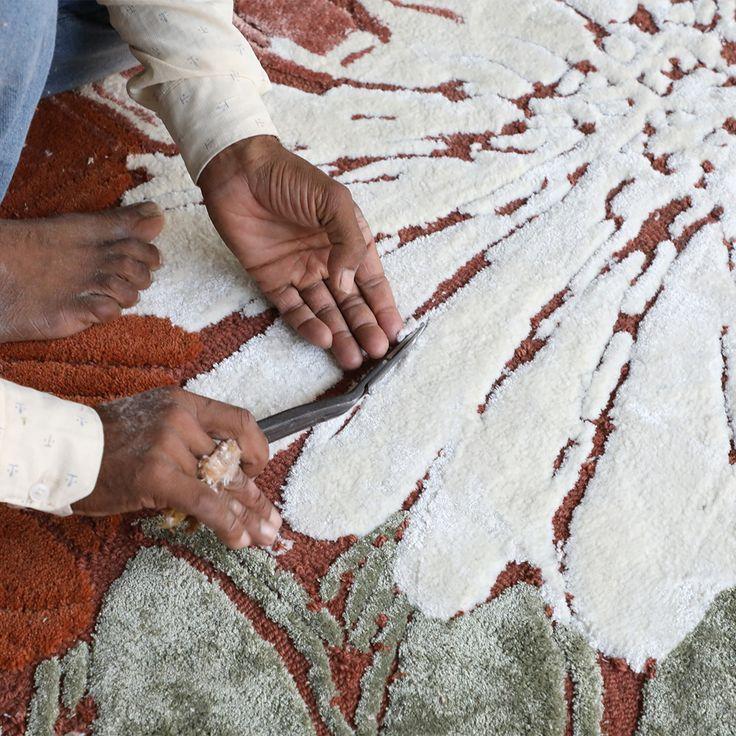
The brief should state the construction type: hand-knotted, hand-tufted, or flatweave. If the designer is open to the weaver's recommendation, say so explicitly, as it allows the supplier to suggest the most appropriate technique for the design intent and budget. A highly geometric pattern with crisp lines reads differently in hand-knotted wool (which has a slightly textured pile) than in a low-pile tufted construction or a flatweave.
Pile height communicates tactility and visual weight. A deep pile reads luxurious and soft underfoot; a low cut pile reads precise and graphic; a looped pile reads textural and informal. Specify the desired pile height in millimetres rather than using adjectives, or request samples in two or three pile heights so the client can choose with their hands rather than from a description.
Material choice interacts with colour. Silk and bamboo silk fibres carry colour with a luminosity that wool does not, because of their light-reflective surface. A design that relies on depth and shimmer may need a silk or silk-blend specification. Our weaving overview illustrates how different fibres behave in the finished piece.
The Sample Approval Process
Request a woven sample, ideally at least 30x30cm, in the specified construction, pile height, colourway, and, where possible, a representative motif from the design. Assess the sample under natural light and artificial light in the actual room or a room with comparable lighting conditions. Show it to the client against the key finishes it will read against: the floor, the primary upholstery, the wall colour.
If changes are needed, provide written, specific feedback rather than general commentary. "The blue reads too cool" is less useful than "the blue in the border should shift warmer by approximately 10 percent, closer to the slate tone in the upholstery swatch I sent." Written feedback creates a paper trail that prevents the same conversation recurring at the next sample stage.
Timeline, Revisions and What to Build into Client Expectations
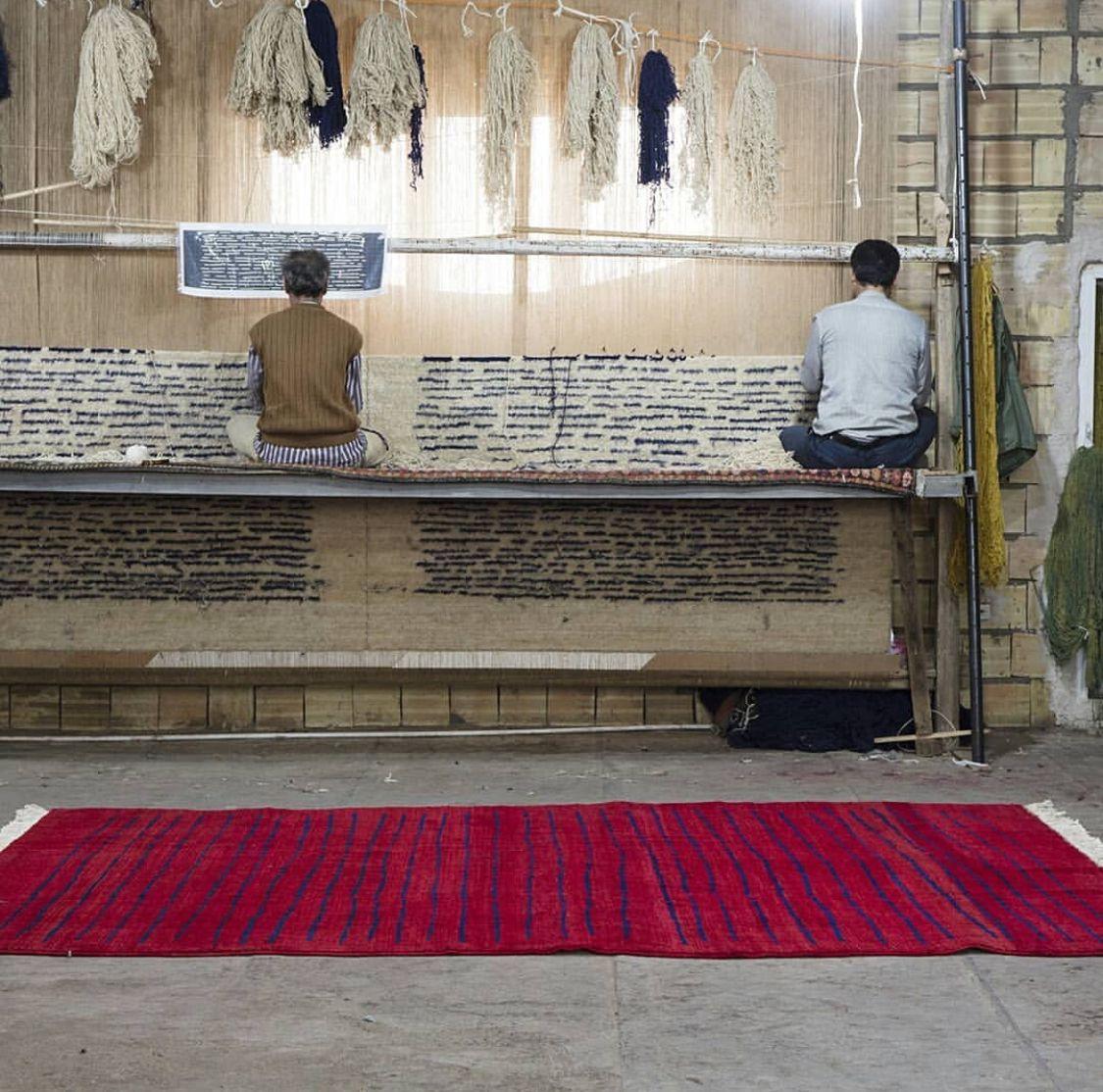
Custom rug commissions take time. A hand-knotted piece woven to a custom design requires loom set-up, sampling, client approval, and production before shipping. Designers who set realistic timelines with clients from the outset avoid the pressure that leads to cutting corners at the sample stage.
Build at least two sample rounds into your project timeline and budget. The first sample often reveals something about the colour, scale, or texture that the brief did not anticipate. The second sample should be the approved version, and production should not begin until that approval is in writing.
For designers who work on multiple projects simultaneously, our personal curation service and trade programme offer a more structured collaboration framework, with access to our archive for design reference and a dedicated account contact for each project.
Frequently asked
Can I supply my own design artwork for a custom rug?
Yes. We accept artwork in vector format (AI, EPS, PDF) or high-resolution raster files. Our design team will review the file and advise on how the artwork translates into a woven repeat, including any simplifications required to suit the construction technique chosen.
What is a tuft card and when should I request one?
A tuft card is a small physical sample showing the proposed yarn colours in the actual fibre and pile height, before a full woven sample is made. It is a quick and low-cost way to check colour accuracy and adjust the palette before committing to a larger sample.
Is there a minimum size for a custom commission?
Minimum sizes depend on construction type. Some constructions have loom constraints that make very small pieces inefficient. Contact our team with your specific dimensions and we will advise on the most practical approach.
Can I order a custom rug as a one-off piece, or is a minimum quantity required?
One-off bespoke commissions are a significant part of our work, particularly for residential interior design projects. Minimum quantities apply primarily to wholesale and repeat production programmes rather than single custom pieces.
By RS, 14 October 2025
More in For Interior Designers.
Follow the journal in Google Search. Readers who add us as a preferred source see our writing marked in Top Stories and in AI Overviews.