Where Every Commission Begins: The Design Brief
A bespoke rug commission at Raheem and Son begins not on the loom floor but in conversation. Before any technical work starts, our team works to understand the space: its proportions, its light, the materials already present, and the mood the designer or architect is trying to achieve. A strong design brief is the foundation on which every subsequent decision rests.
The brief covers scale, palette, pile direction, material preferences and, critically, the function of the rug. A residential drawing room has entirely different requirements from a hotel lobby corridor. We ask about foot traffic, cleaning protocols, and whether the piece will be fixed or moved seasonally. These are not administrative questions. They shape the construction before a single design line is drawn.
Designers working on complex or multi-room schemes can request a consultation through our personal curation service, which allows for a more structured dialogue before the formal commission begins.
Technical Drawing and the Point Paper
Once the brief is agreed, the design moves to what weavers call the point paper, a graph-based technical drawing where each square represents a single knot. Every colour, every gradient, every geometric shift must be resolved at this stage. For a rug of medium complexity, a point paper can take several days to produce with precision.
Digital tools have made this process more accurate, but the fundamental logic has not changed in over a century. A hand-knotted rug is a binary grid of colour decisions repeated thousands of times per square metre. The point paper converts a fluid design concept into a set of precise, unambiguous instructions that a weaver can follow at the loom without having to interpret or improvise.
At Raheem and Son, our in-house designers work closely with the enquiring party at this stage. Revisions are encouraged. It is far less costly to change a colour in the point paper than to unpick completed rows of knotting. We strongly recommend clients approve the technical drawing before production begins.
You can read more about how our rug-making process translates drawing into physical textile.
Material Selection: Wool, Silk and the Foundations
With the design resolved, attention moves to material. For most commissions, the pile is hand-spun or semi-spun wool sourced from highland flocks, chosen for its natural lustre and durability. Where the design calls for fine detail, silk or bamboo silk may be blended into specific sections to catch light differently and sharpen lines.
The foundation, typically cotton warp and weft, is chosen for its tensile strength and dimensional stability. Cotton does not stretch under tension the way wool does, which is what keeps a large hand-knotted rug flat and dimensionally true across decades of use. The foundation is invisible in the finished piece but entirely responsible for its structural integrity.
Dye lots are prepared before knotting begins. If natural dyes are specified, the dyeing process adds several weeks, as the yarn must be mordanted, dyed, and dried before it can be wound onto bobbins for the weaver. Colour accuracy is verified under multiple light sources at this stage to ensure the palette holds across different interior conditions.
Setting the Loom and Beginning to Knot
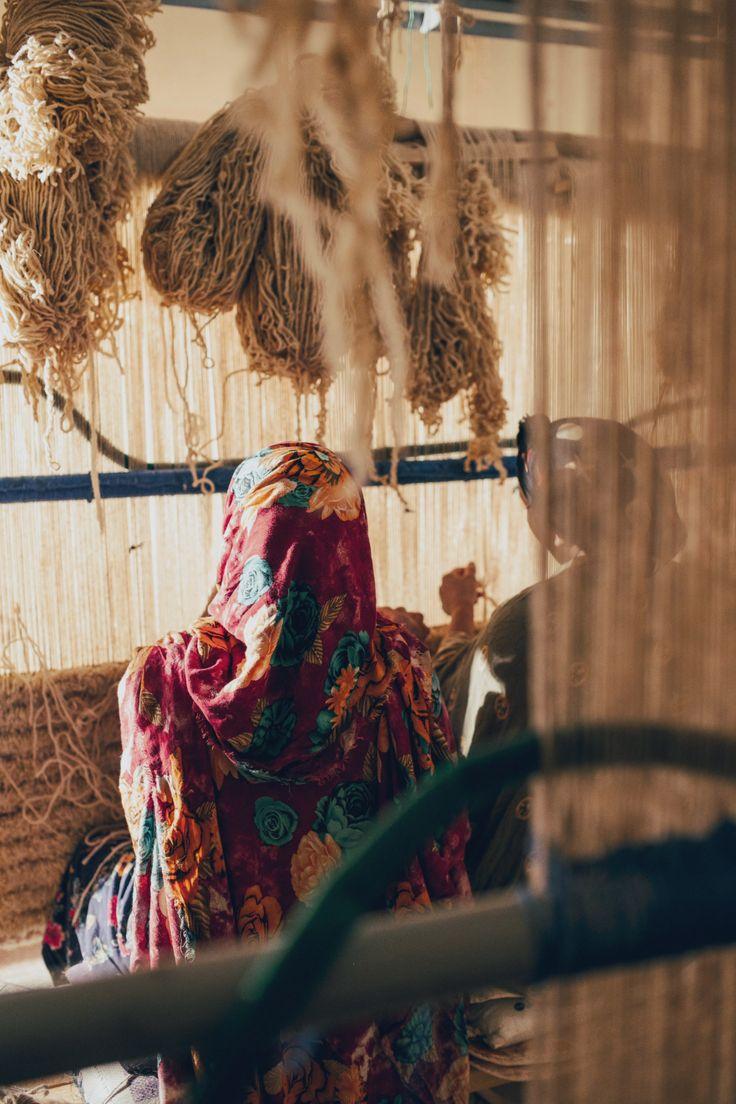
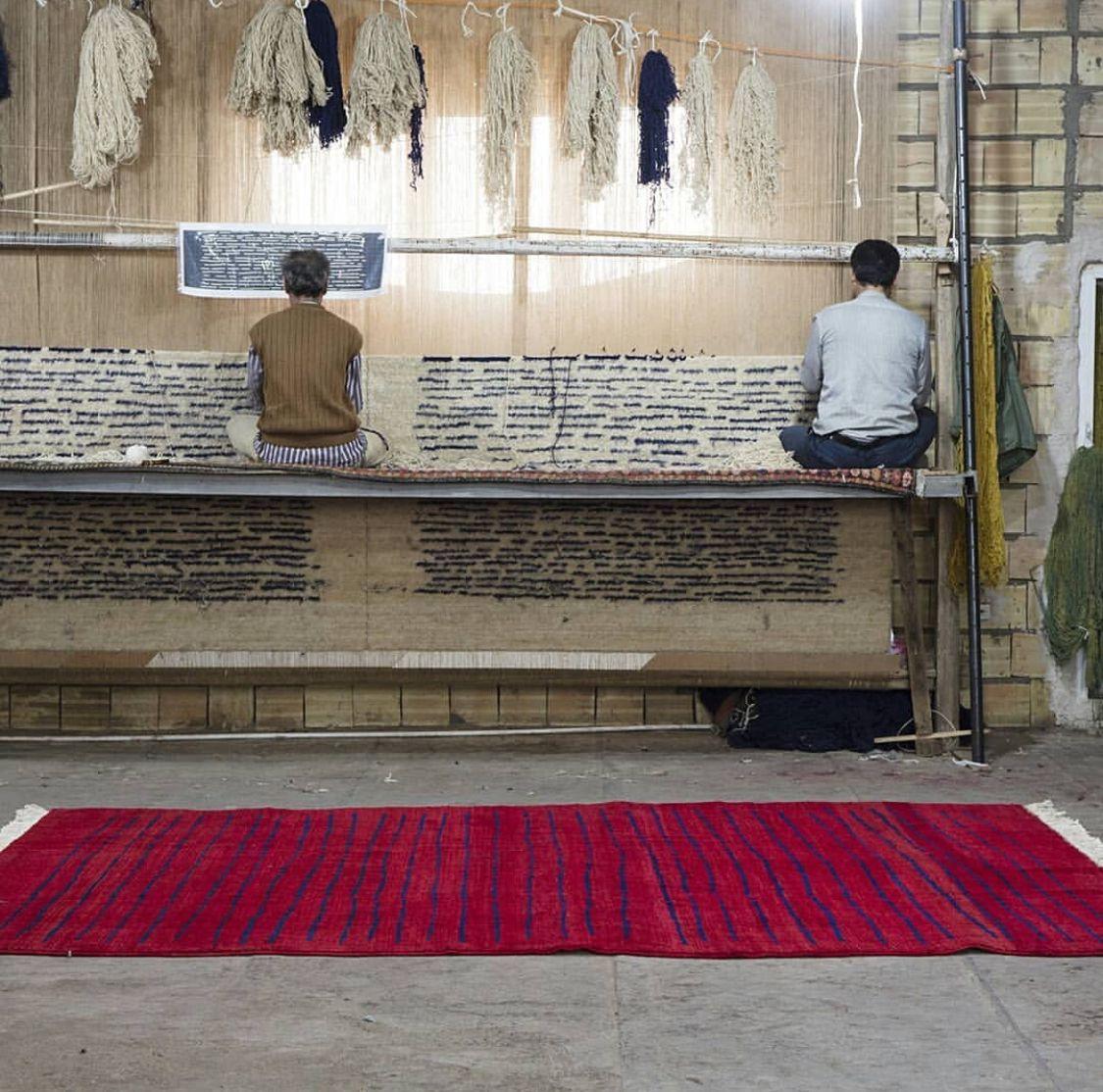
The loom is set with vertical cotton warps at the density called for by the chosen knot count. Higher knot counts require finer warp threads set more closely together, which demands a more experienced weaver and a longer production timeline. Once the loom is dressed, a master weaver reviews the point paper and begins working row by row from the bottom of the rug upward.
Each knot is tied by hand around two warp threads, cut to pile height, and tamped down with a metal comb before the next row is woven in. At a standard knot count, a skilled weaver working a full day produces a relatively small area. A large bespoke piece with detailed patterning can take months to complete. This is not a constraint to apologise for. It is precisely what makes the object valuable.
Progress can be shared with clients at agreed intervals. We photograph the rug on the loom so that any divergence from the approved design can be identified and corrected before it compounds. This is particularly important for commissions involving gradients or custom colour fields that are difficult to verify from the point paper alone.
Finishing: Washing, Clipping and Inspection
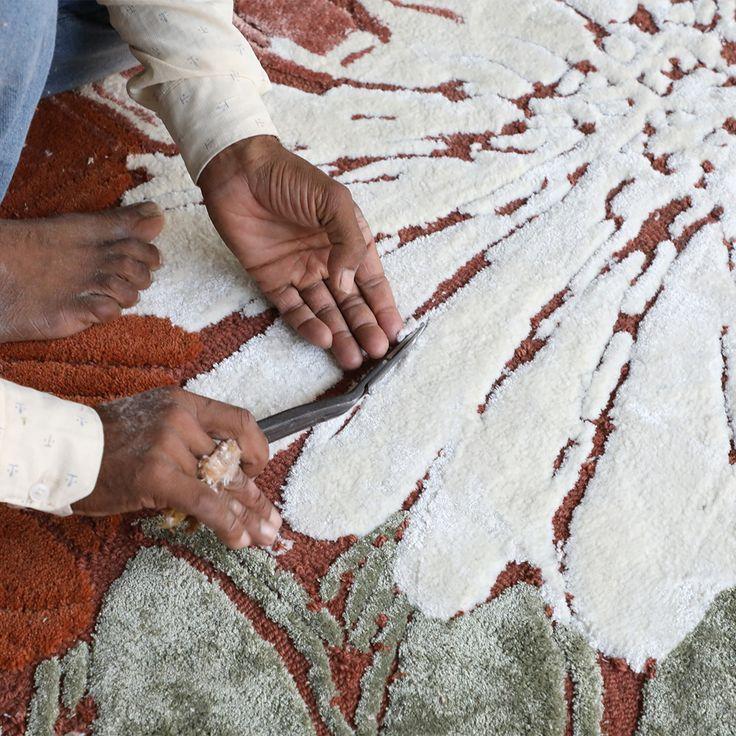
When the knotting is complete, the rug is cut from the loom and the pile is clipped level. This is a skilled operation. An uneven clip shows immediately in raking light. At Raheem and Son, finishing is done by hand, not machine, with shears guided by experienced craftspeople who understand how to follow the design rather than cut mechanically across it.
The rug is then washed. Washing softens the pile, removes lanolin residues from the wool, and begins to settle the fibres into their final relationship with one another. After drying, which for a large piece takes several days in open air, the rug is inspected flat under strong light. Any irregularities are corrected before the piece leaves the workshop.
The result of this process is a rug that is not merely decorative but genuinely made. Each stage has been handled by a person making decisions, not a machine following parameters.
How Long Does a Bespoke Commission Take?
The honest answer depends on the complexity of the design, the knot count, the size, and whether natural dyes are specified. A straightforward commission with a geometric pattern and stock colours can move from brief to finished piece in three to four months. A highly detailed design with custom natural dyes and a fine knot count may require six to nine months or more.
Designers who are working to a project deadline should factor this lead time into their specification schedule. We recommend initiating a commission as early in a project as possible, ideally at the concept stage when the broad palette and scale are known even if the final design is not yet fixed.
For projects requiring multiple bespoke pieces, such as a hotel opening or a large residential development, our contract manufacturing team can plan a production schedule across multiple looms to meet a coordinated delivery.
Working with Our Studio on Your Next Commission
Commissioning a rug from Raheem and Son is a collaborative process. We do not expect clients to arrive with a finished technical brief. Our role is to translate a design intention, whether that arrives as a mood board, a sketch, a fabric swatch, or a verbal description, into a production-ready point paper that the weaving team can execute with confidence.
The process works best when communication is open and timelines are realistic. We welcome clients and their designers to visit our atelier in Bhadohi during production for longer commissions. Seeing the rug on the loom at an early stage often sparks refinements that improve the final piece significantly. Contact our team through /contact to begin a conversation.
Frequently asked
How do I start a custom rug commission with Raheem and Son?
Begin by contacting our team with a brief description of the project, including approximate size, palette, and any reference images. We will arrange a consultation to develop the brief in detail before any technical work begins.
Can I make changes to the design after the point paper is approved?
Minor changes may be possible early in production, but significant alterations once knotting has begun are difficult and may affect the timeline. We recommend thorough review and approval of the technical drawing before production starts.
Does the minimum size change with the construction?
We work across a wide range of sizes, from statement accent pieces to large-format architectural rugs. Please contact our team to discuss your specific requirements, as minimum sizes can vary by construction type.
Do you offer natural dyes for custom commissions?
Yes. Natural dye options are available and add depth and character to the finished piece. They do extend the production timeline, as the dyeing process requires additional stages. Our team can advise on which natural palettes work well for specific design intentions.
By RS, 4 September 2025
More in For Interior Designers.
Follow the journal in Google Search. Readers who add us as a preferred source see our writing marked in Top Stories and in AI Overviews.