How the Two Constructions Are Actually Made
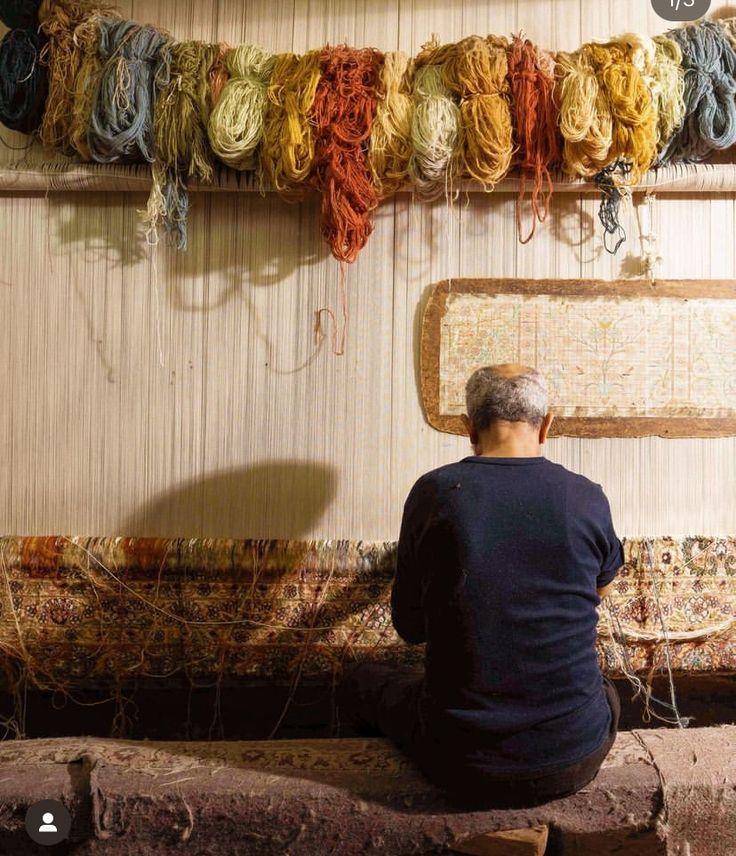
In a hand-knotted rug, each individual tuft of pile yarn is tied around the warp threads with a knot, row by row, across the full surface of the rug. After each row of knots, weft threads are passed through the warp to lock the row in place before the weaver moves to the next. The process is slow and entirely manual; a skilled weaver working at a moderate knot density can complete roughly one square foot per day on a standard loom. This is the construction that has been used in the great weaving traditions of Persia, Turkey, Central Asia, and India for centuries.
In a hand-tufted rug, pile yarn is punched into a pre-stretched canvas backing using a hand-held tufting gun, a pneumatic or electric tool that pushes the yarn through the canvas and creates loops. The operator guides the gun along stencilled pattern lines on the canvas. Once the surface is complete, the loops are cut to create cut pile (or left looped for a loop pile effect), and the reverse of the canvas is coated with latex to secure the tufts. A secondary backing fabric is then adhered over the latex to give the rug a clean underside. The process is substantially faster than hand-knotting. A workshop that produces one hand-knotted rug in several weeks can produce many hand-tufted pieces in the same period.
Visit our weaving overview to see how both constructions are set up on the loom and understand the craft behind each technique. Our collections show finished pieces in both constructions so you can assess the visual and tactile difference firsthand.
Pile Longevity: Why the Foundation Structure Is the Key Variable
The critical difference in longevity between the two constructions comes down to how the pile is anchored. In a hand-knotted rug, the pile yarn is a structural element of the rug's foundation. It is tied around the warp and locked in place by the weft. When the pile wears, it shortens gradually and evenly, revealing the foundation structure as a natural sign of age. The rug can be repaired by re-knotting worn areas using matching yarn and maintaining structural integrity. Well-maintained hand-knotted rugs from quality materials routinely last several decades.
In a hand-tufted rug, the pile yarn is held in place by the latex coating on the reverse of the canvas backing. The latex is the structural element, not the weave itself. Over time, particularly in warm environments or where the rug is subject to regular wet-cleaning, the latex can degrade: it may become brittle, crack, or crumble, causing the tufts to loosen. Once the latex fails, the pile cannot be re-anchored without replacing the backing, which is generally not economical. Hand-tufted rugs are not repairable in the way hand-knotted rugs are.
A hand-tufted rug in good-quality wool and with a robust latex application can perform well for many years in appropriate residential use. The limitation is not that the construction is poor, but that it has a finite structural life and cannot be extended through repair in the way hand-knotted construction can. For long-term investment, heritage value, or high-traffic commercial use, hand-knotted is unambiguously the correct choice.
How to Tell the Two Constructions Apart
The most reliable test is to look at the reverse of the rug. A hand-knotted rug shows the knot structure clearly on the back: the individual knots are visible, the pattern on the reverse mirrors the pattern on the pile face, and the warp and weft threads are evident as a structural grid. The back of a hand-knotted rug is a demonstration of the craft, not something to be hidden.
The reverse of a hand-tufted rug looks completely different: a flat, smooth surface of secondary backing fabric, usually a woven cotton or non-woven synthetic material, adhered over the latex layer. The pattern is not visible from the reverse. If you peel back a corner of the secondary backing (which you should only do if the rug is your own), you will see the latex coating and, beneath it, the canvas into which the tufts are punched.
A second test, less reliable but useful when you cannot access the reverse, is to look at the pile surface at an angle. Hand-knotted pile, particularly in finer constructions, shows very slight natural variation in the pile direction and height that is characteristic of hand production. Hand-tufted pile tends to be more uniformly level because the tufting gun applies yarn at a consistent rate. This difference is subtle and not a reliable test in isolation, but it reinforces what the reverse examination shows.
Design Detail and What Each Construction Can Achieve
Hand-knotted construction is capable of extraordinary design detail at high knot densities. Fine Persian-style designs with complex curvilinear motifs, delicate floral borders, and intricate medallions are products of high-count hand-knotted weaving. The limitation is that very fine detail requires very high knot density, which extends production time and cost. Designs that are inappropriate for hand-knotted construction are those that demand perfectly straight diagonal lines at low angles, because the stepped nature of knotted construction produces slight stair-stepping effects in diagonals.
Hand-tufted construction, because the tufting gun follows a stencil, can produce very sharp, clean lines and precise geometric patterns efficiently. Complex photographic or illustrative designs that would be prohibitively expensive in hand-knotted construction can be produced in tufted form at a fraction of the cost. The trade-off is that the visual depth and texture of the pile surface is different: hand-knotted pile, particularly in highland wool, has a natural vitality and slight irregularity that tufted pile does not fully replicate.
For many design applications, particularly modern geometric and abstract patterns at accessible price points, hand-tufted construction is entirely appropriate and produces a beautiful result. The construction should be chosen for what the project requires, not rejected simply because it is not hand-knotted. Our team can advise on which construction best suits your design brief and budget during the initial consultation.
Price Differences and What They Actually Reflect
Hand-knotted rugs are more expensive than hand-tufted rugs of the same size and apparent quality for one reason: they require more skilled labour and more of it. A hand-knotted rug at a moderate knot density in a standard size represents weeks of a skilled weaver's working time. A hand-tufted rug of the same size can be produced in a fraction of that time. The price difference is a direct reflection of the labour content, not a marketing premium.
When a hand-knotted rug appears to be priced at or near the level of a comparable hand-tufted piece, one of three things is true: the knot density is very low (which limits design detail and durability), the fibre quality is below standard, or the piece is misrepresented. Buyers sourcing at scale should be alert to this and request a written specification sheet alongside any sample, confirming knot density, pile fibre, and construction method in measurable terms.
The long-term economics are also different. A hand-knotted rug amortised over its full lifespan often represents a lower cost per year of use than a hand-tufted piece replaced every several years. For buyers equipping a long-term installation, or for interior designers advising clients on investment value, this total cost of ownership argument is worth making explicitly.
Which Construction to Recommend for Specific Applications
For prestige residential spaces, heirloom pieces, and long-term installations where the rug is expected to outlast multiple redecoration cycles, hand-knotted construction in quality wool or silk is the right specification. For hospitality and contract applications in high-traffic areas where regular replacement is planned anyway, hand-tufted construction in a robust pile fibre at a competitive price point may be the more practical and commercially sound choice.
For retail ranges targeting the design-conscious consumer at accessible price points, hand-tufted construction allows you to offer design diversity and colour range at a margin that works for retail without compromising on surface quality. Position these pieces honestly: the integrity of the construction, its appropriate lifespan, and the care it requires should all be communicated clearly to the end buyer.
We produce both constructions and recommend each honestly based on the project's requirements. Visit our collections to see the range in both constructions, or contact our weaving team to discuss which is most appropriate for your specific brief. We do not oversell hand-knotted construction where hand-tufted genuinely serves the application better.
Frequently asked
Will a hand-tufted rug shed pile fibres?
New hand-tufted rugs may shed some loose fibres in the first weeks of use, which is normal. Persistent or excessive shedding can indicate that the pile fibres were not anchored adequately by the latex, or that the pile quality is lower. A well-made hand-tufted rug should shed only minimally after the initial break-in period.
Can a hand-tufted rug be repaired if it is damaged?
Minor surface repairs to a hand-tufted rug (replacing localised pile loss) are possible but more complicated than repairs to hand-knotted rugs because the tufts are held by latex rather than by the weave structure. Structural repairs to the backing are generally not economical. For an investment piece you expect to repair and maintain over decades, hand-knotted construction is the appropriate choice.
Is hand-knotted always better than hand-tufted?
Not always. Hand-knotted is more durable, more repairable, and more valuable as an investment. But for many residential applications, hand-tufted construction in quality wool or bamboo silk performs well and offers design detail and price accessibility that hand-knotted cannot match at the same budget. The right choice depends on the application, the lifespan expectation, and the budget.
Do hand-tufted rugs work for underfloor heating?
Latex backing can be affected by sustained heat from underfloor heating systems. If you are specifying a rug for a room with underfloor heating, discuss this with the manufacturer and consider a hand-knotted or flatweave construction with a natural backing, which conducts heat more predictably than latex-backed tufted construction.
By RS, 17 June 2026
More in Materials and Construction.
Follow the journal in Google Search. Readers who add us as a preferred source see our writing marked in Top Stories and in AI Overviews.