Why Poufs and Ottomans Have Become a Core Category
The pouf has moved from an occasional accent piece to a staple of contemporary home furnishing retail. Its appeal is practical: it functions as a footrest, an occasional seat, a side table surface, and a visual anchor for a seating grouping, all in a compact format that does not require permanent floor space. For smaller homes, urban apartments, and flexible-living environments, this multi-function character is decisive. For retailers, poufs carry strong margins relative to their shipping volume and are a reliable category for repeat purchasing as consumers move them between rooms or replace them as trends shift.
India is among the leading production sources for handmade poufs globally. The concentration of textile and leather craft in regions including Bhadohi, Agra, and Jodhpur means that buyers can source a wide range of pouf constructions, materials, and sizes from within a single country origin, simplifying compliance documentation and supply-chain oversight. Our poufs page gives an overview of the categories we produce and the customisation available to trade buyers.
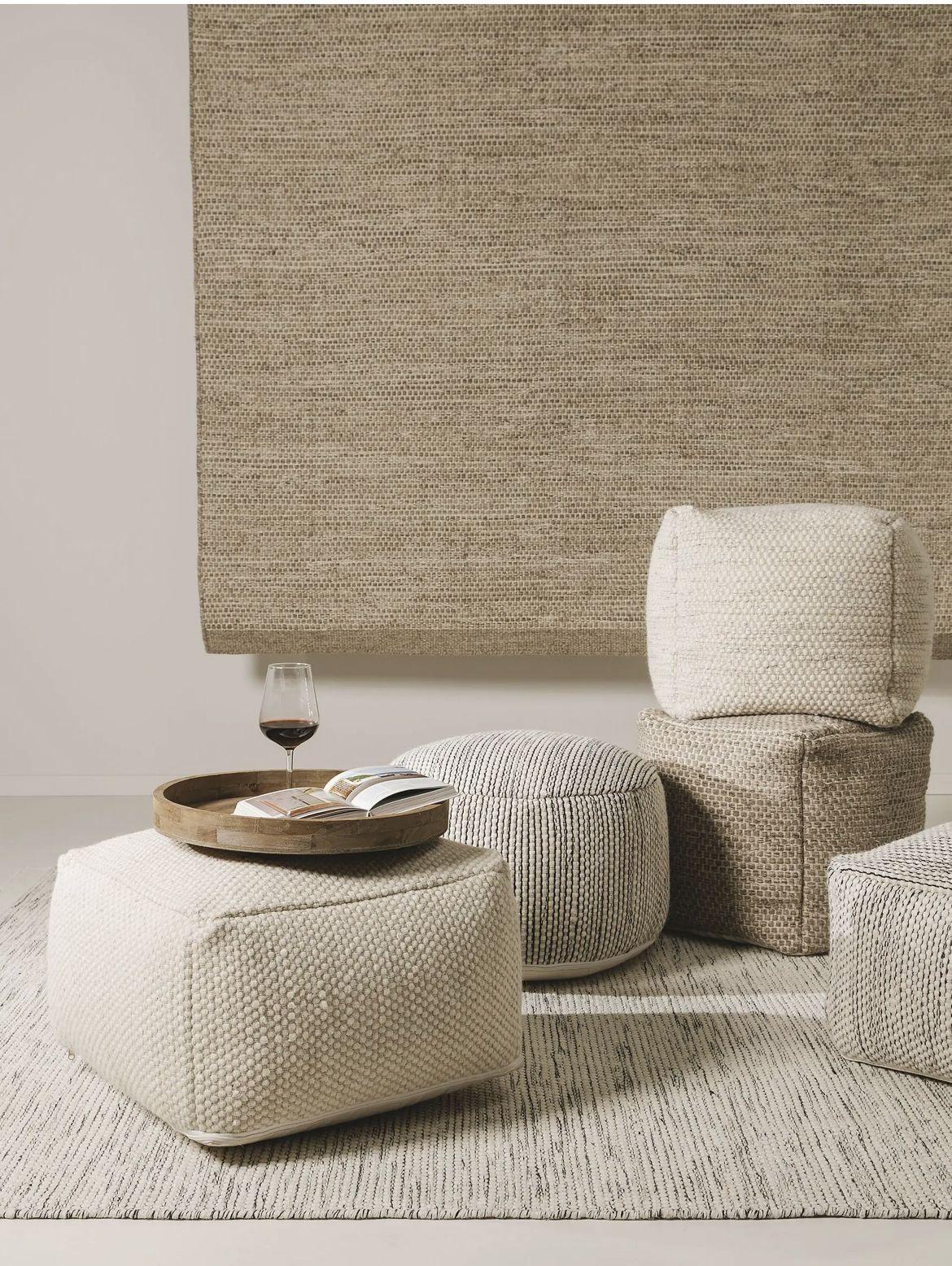
The categories within the pouf market are more varied than they might appear from a retail perspective. Kilim-covered poufs, leather Moroccan-style round poufs, embroidered cotton poufs, tufted fabric ottomans, and braided jute poufs all coexist in the broader market and appeal to different consumer segments and interior aesthetics. Understanding which construction suits your buying programme is the first step in a productive sourcing conversation.
Construction Types and Materials: A Quick Reference
Kilim-covered poufs use flatwoven textile, typically repurposed or purpose-woven kilim fabric, stretched over a structured inner form. The kilim surface provides a richly patterned, durable outer shell, and the construction aligns naturally with buyers who also carry kilim or flatweave rugs. The inner form is typically a cotton canvas casing that ships flat (unstuffed) and is filled locally with polyester fill, shredded foam, or traditional cotton waste. Flat-packed shipping dramatically reduces freight cost per unit.
Leather poufs, most commonly the round Moroccan-style pouf known as a poire or Moroccan hassock, are constructed from hand-stitched leather panels in a sphere or low disc form. The leather is typically vegetable-tanned, hand-embossed or punched with geometric patterns, and stitched with contrasting thread. These poufs also ship flat and are filled by the retailer or end consumer. Indian production of Moroccan-style leather poufs has grown substantially in recent decades, offering comparable quality at more competitive pricing than North African origin.
Braided and woven poufs in cotton, jute, or recycled fibre have expanded in line with the natural materials trend. These constructions range from tightly coiled rope poufs to open-weave structures, and they appeal to buyers looking for an eco-positioned alternative to leather or synthetic-covered options. Embroidered or hand-blocked fabric poufs round out the category for buyers targeting the artisan-aesthetic consumer segment. Each construction has different production lead times, with leather poufs generally requiring the longest finishing time of the main categories.
Sizing, Fill Options, and Shipping Logistics
Standard pouf sizes range from small accent forms at around 30 to 40 cm diameter and 25 cm height, through mid-size at 45 to 50 cm diameter, to large floor poufs at 60 cm diameter and above. Round, square, and rectangular forms each have their market. Confirm the size range with your retail team before ordering, as consumers are size-sensitive in this category and incorrect sizing is a common reason for returns.
Fill options for flat-packed poufs include polyester fibre fill, shredded foam, recycled cotton batting, and traditional Indian cotton waste (locally called Desi cotton or kapok cotton waste). Polyester fill is the most widely available and easiest for consumers to source locally. Some buyers prefer to specify fill weight or density in the product description to manage consumer expectations. Confirm with your supplier whether fill is included or must be sourced locally, as this affects the landed cost calculation.
Flat-packed poufs ship very efficiently. A standard 20-foot shipping container holds many more unstuffed poufs than any equivalent volume in furniture. Buyers who are cost-conscious should confirm whether their supplier packs poufs flat or pre-stuffed, as pre-stuffed poufs occupy several times the shipping volume and weight per unit. For high-volume wholesale programmes, flat-pack is almost universally preferable. Contact our team via our request-bulk-quote page to discuss container-load pricing.
Quality Checkpoints for Pouf Production
Pouf quality is assessed across three components: the outer cover, the inner casing, and (where included) the fill. The outer cover should be assessed for stitching integrity at all seams, particularly the base seam where stress is highest in use, colourfastness to rubbing and light, and accurate pattern alignment on kilim or printed fabric versions. Leather outer covers should be checked for even tanning, consistent surface finish, and secure closure at the fill opening.
The inner casing, where the pouf ships flat, is a structural component that must be robust enough to hold fill without seam failure. Canvas weight of at least 350 grams per square metre is a reasonable baseline. Zips or laced closures should be heavy-duty and rated for repeated opening and filling. Poufs with flimsy inner casings generate customer complaints regardless of how attractive the outer cover is.
Pre-shipment inspection on poufs should include a pull test on all seams, a check for zipper or lace closure function, and a colour assessment under standard illuminant. For kilim and embroidered covers, check that the pattern is centred and consistent across the production batch, as misaligned covers are a common production variance that is easier to catch before shipment than to resolve after.
Minimum Orders, Lead Times, and Private Label Options
Raheem and Son does not impose a blanket minimum order quantity on pouf programmes. Production viability depends on the construction complexity, the size of the design run, and the fabric or leather sourcing involved for each design. Buyers with smaller initial orders are encouraged to share their full programme structure so we can identify the most practical minimum for each line rather than applying a single number across the range.
Lead times for pouf production typically fall within a shorter window than for rugs, because the construction is less labour-intensive per unit. Simple flat-pack poufs in stock fabric or kilim constructions can often be sampled and moved to production within timelines comparable to our rug sampling window of 25 to 35 days for sampling and 60 days for bulk production. Custom leather or embroidered constructions require additional time for pattern development and sourcing.
Private label and OEM programmes are available for pouf buyers who want to build a proprietary product range. Custom labels, swing tags, and branded packaging are all available, and we have experience working within the packaging specifications of major European and North American retailers. Discuss your requirements at the brief stage to confirm lead time and cost implications.
Trends and Design Directions Worth Tracking
The current design conversation in poufs and ottomans is being shaped by two parallel movements. The first is the natural materials direction, where buyers and consumers are choosing jute braid, recycled cotton rope, and undyed natural leather over synthetic or brightly coloured alternatives. The second is a return to rich pattern, driven partly by social-media-driven interest in global craft traditions, where embroidered, kilim-patterned, and hand-blocked poufs carry the aesthetic authority that a plain product cannot.
Shape is also diversifying. Beyond the classic round and square, low elongated ottomans that function as coffee tables, hexagonal forms for geometric arrangements, and stacking sets of graduated-size poufs are all gaining traction in retail ranges. If your buying programme extends to these forms, confirm whether they require custom inner casing tooling or whether standard forms can be adapted.
Frequently asked
Do poufs ship flat or pre-stuffed?
Most wholesale pouf orders ship flat (unstuffed) to minimise freight costs. The buyer or end consumer fills the pouf with polyester fill, recycled cotton, or a similar material on receipt. Some constructions, particularly pre-formed leather poufs, ship pre-stuffed, which affects the shipping volume and cost per unit significantly.
What is the difference between a kilim pouf and a Moroccan leather pouf?
A kilim pouf has an outer cover made from flatwoven kilim fabric, typically in geometric patterns in wool or wool-cotton blend. A Moroccan leather pouf has an outer cover of hand-stitched vegetable-tanned leather, often with embossed or punched geometric decoration. Both are typically flat-packed. The kilim pouf is generally lighter; the leather pouf is more durable in high-use settings.
Can I order poufs with my own brand label?
Yes. Private-label programmes with custom tags, labels, and packaging are available. Share your requirements at the briefing stage so we can confirm lead time and minimum quantities for branded packaging production alongside the pouf order.
Are there fire safety requirements for poufs in commercial settings?
Fire safety requirements for poufs in commercial settings vary by market. In the UK, upholstered furniture for commercial use must meet the Furniture and Furnishings (Fire Safety) Regulations. In the US, requirements vary by state. Confirm the applicable regulation for your market with your compliance team and share the requirements with your supplier at the briefing stage.
By RS, 14 June 2026
More in Sourcing and Suppliers.
Follow the journal in Google Search. Readers who add us as a preferred source see our writing marked in Top Stories and in AI Overviews.