What a Rug Archive Actually Contains
A working archive at a heritage rug house is not a static collection. It is a compendium of solved problems: design compositions that have been translated into loom-readable cartoons, tested against fibre and dye, and proven to work at specific knot densities and scales. Each drawing represents a collaboration between a designer who composed it and weavers who interpreted it, and the lessons of that collaboration are embedded in the paper itself.
The archive typically contains original cartoons, the gridded paper guides that weavers follow row by row at the loom. Alongside these are colour references, often hand-painted or yarn-sampled, that establish the dye lots for each field and motif. There may also be correspondence, production notes, and in some cases photographs of the finished piece, allowing later designers to compare the drawn intention with the woven result.
At Raheem and Son, our archive spans nearly a century of production. Drawings from the mid-twentieth century record pattern traditions that were themselves inherited from earlier sources, creating a continuous thread back to classical Persian, Mughal, and tribal design vocabularies. Exploring our collections reveals how many of our current offerings draw directly from this archive.
The Cartoon as Technical Document
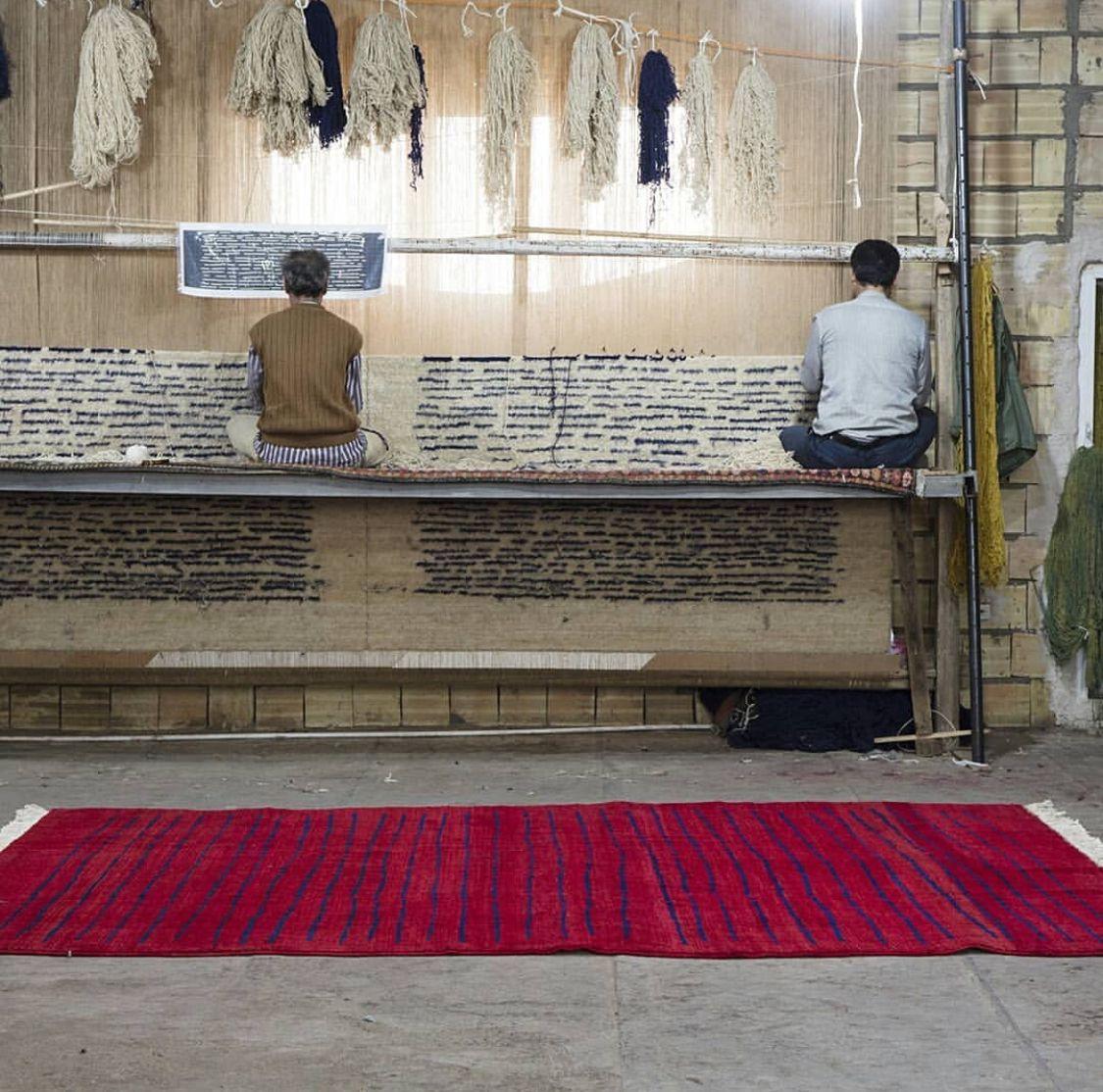
It is easy to mistake a rug cartoon for a design illustration. It is not. A cartoon is a technical document that encodes the exact sequence of knots across and up the loom. Each cell in the grid represents one knot, and each knot is assigned a colour corresponding to a specific yarn. The weaver reads this grid line by line, tying knots in the sequence the grid prescribes.
The precision this requires means that the cartoon must be drawn at a scale corresponding to the knot density of the rug. A cartoon for a fine-count rug with many knots per square decimetre will have very small cells; a cartoon for a coarser tribal design will have larger cells representing fewer, larger knots. The physical size of the cartoon therefore encodes the structural specification of the rug.
Old cartoons also record the solutions their designers found to particular compositional challenges: how to manage a curved border on a rectilinear grid, how to render a realistic floral motif at a given knot count, how to balance a large medallion against a densely filled field. These solutions are not obvious, and rediscovering them independently is time-consuming. The archive makes them immediately available.
Why Old Drawings Are Not Obsolete
Contemporary design often treats historical reference with ambivalence: relevant enough to inspire, too old-fashioned to use directly. In rug design, this ambivalence deserves examination. The motifs and compositional structures in historic cartoons are not dated in the way that a mid-century furniture silhouette might be. Many of them are abstract enough, or naturalistic in ways that remain perennially legible, that they read as fresh in contemporary interiors.
More importantly, historic cartoons carry proportional relationships that have been refined over long periods of use. The ratio of border width to field, the scaling of medallions relative to room size, the density of filling motifs against ground: these proportions were arrived at through empirical practice rather than theoretical calculation. They tend to work because they have been tested across many iterations and in many room types.
Designers who commission bespoke rugs often find that working from an archive drawing is more efficient than designing from scratch. The foundational composition is already resolved; the commission becomes a conversation about colour, scale, and adaptation rather than a complete design process.
Adapting Archive Patterns for Contemporary Commissions
An archive drawing is a starting point, not a constraint. The most productive use of a historical cartoon is to take its compositional logic, the spatial relationships between elements, and reinterpret it in materials and colours suited to the contemporary commission.
A nineteenth-century medallion design originally woven in deep crimson and indigo on a dark ground might be reinterpreted with a single-colour field in pale sand, the medallion rendered in a slightly deeper tone of the same natural undyed wool. The result is a composition with the structural clarity of the historical source but a visual register entirely suited to a quiet-luxury contemporary interior. The archive enables this because the compositional work has already been done.
Our personal curation service often begins with a review of relevant archive material in relation to a designer's brief. This process allows us to propose compositions that are historically grounded but configured specifically for the project at hand, offering both precedent and originality.
Motifs and Their Meanings: What the Archive Records
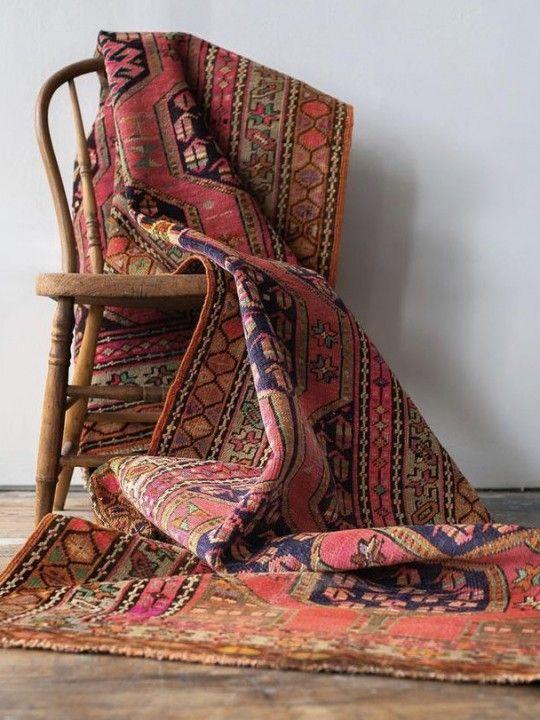
Historic rug motifs carry iconographic traditions that stretch back centuries. The boteh, the paisley-like form familiar from Kashmiri and Persian carpets, appears in designs spanning a range of cultural contexts and has been interpreted as a leaf, a cypress tree, a teardrop, and various spiritual symbols depending on the tradition. The herati pattern, a formal repeat of a rosette within a diamond with leaves, is one of the most widely reproduced compositions in carpet history.
The archive records not only what these motifs look like but how they were composed and adapted across generations. A single archive may hold multiple interpretations of the herati, each slightly different in the weight of the line, the density of the rosette, or the proportion of the enclosing diamond. These variations are the trace of individual designers and weavers working within a shared tradition while contributing their own adjustments.
For collectors, this iconographic depth is part of the appeal of historically informed rugs. Our piece on patterns and motifs explores the major design families in greater depth.
Preserving the Archive for Future Designers
Paper archives are fragile. Cartoons drawn on graph paper or linen degrade through humidity, light, and handling. Many historic rug archives have been lost through fire, flood, or simple neglect, and with them the specific compositional knowledge they encoded. The loss is not recoverable; even the most skilled designer cannot reconstruct a specific historical composition from memory.
Digital archiving, the high-resolution scanning of original cartoons and their cataloguing in searchable databases, is one response to this fragility. The digital copy does not fully replace the original, which may carry colour samples and tactile information the scan cannot capture, but it ensures that the compositional content survives in usable form.
At Raheem and Son, we are committed to the ongoing maintenance and extension of our archive as a resource for both our own production and for the broader field. Commissions that result in new cartoons add to the archive; each new piece becomes part of the institutional memory that future designers and weavers will draw upon. Contact us to discuss how archive resources might inform your next commission.
Frequently asked
Can designers request access to historic cartoons when commissioning a rug?
Yes. For bespoke commissions, we can share relevant archive drawings as reference material and discuss which compositions might be adapted for your project. Contact our team to begin that conversation.
Are motifs from the archive protected by copyright?
Traditional motifs that are centuries old are not subject to copyright. Specific artistic interpretations created in recent decades may carry intellectual property considerations; we discuss these case by case in commission contexts.
What is the oldest design in your archive?
Our oldest documented cartoons date from the first decades of the twentieth century. Many of the patterns they record, however, are derived from design traditions that are considerably older.
Can an archive pattern be scaled to any room size?
Most compositions can be scaled with care, though some proportional relationships change character at extreme scales. Our design team reviews scaling implications as part of the commission process.
By RS, 20 October 2025
More in Heritage and Sustainability.
Follow the journal in Google Search. Readers who add us as a preferred source see our writing marked in Top Stories and in AI Overviews.