What Makes a Kilim Different
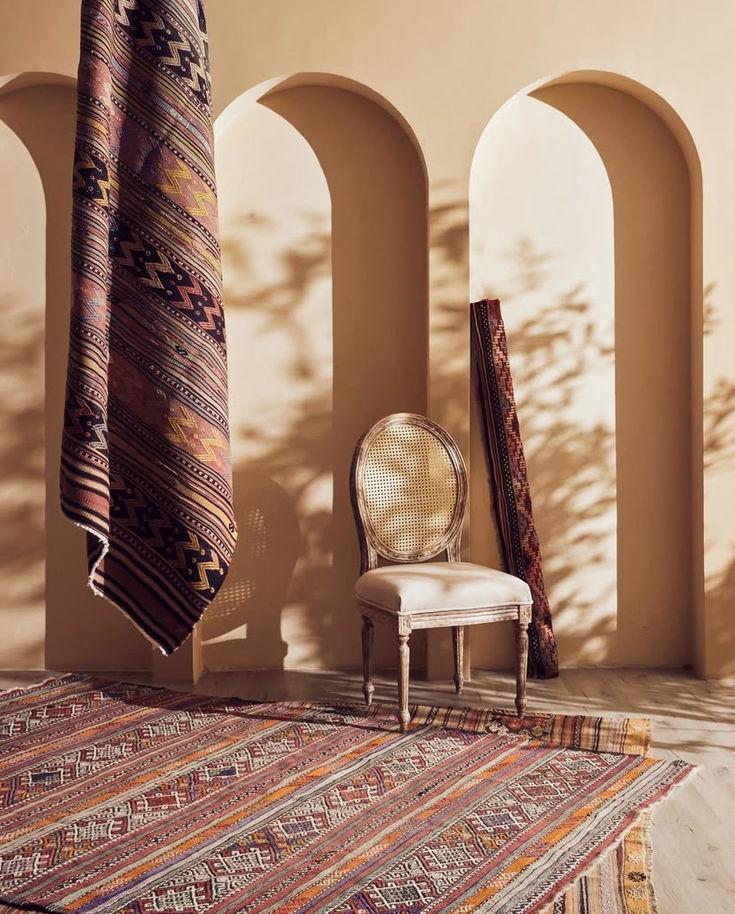
A kilim is a flatweave textile, meaning it has no pile. The pattern is created by interlocking coloured weft threads across the warp rather than by tying individual knots. This produces a thinner, lighter, and typically more graphic object than a pile rug. The designs are often bold and geometric: strong diagonals, stepped diamonds, serrated borders, and high-contrast colour fields.
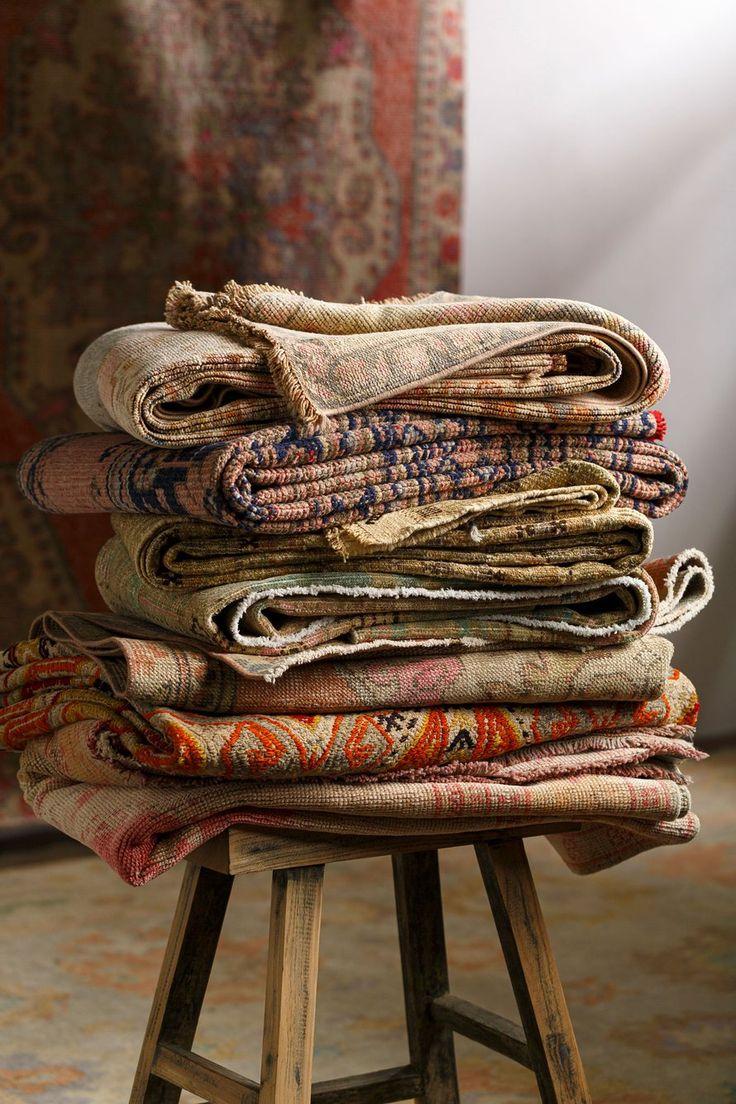
Vintage kilims, which may be decades or even a century old, carry additional depth: the colours have softened with age, the geometric lines have acquired a slight irregularity from years of use, and the overall impression is of an object that has been lived with. These qualities make vintage kilims particularly powerful in interior design, where authentic age is far harder to replicate than contemporary pattern.
The Bohemian Risk and How to Avoid It
The risk with kilims in interior design is the same risk that attends all strongly patterned, strongly coloured objects: they can tip a room from curated into cluttered if handled without care. The bohemian interior, at its worst, is simply an accumulation of interesting objects with no governing principle. At its best, it is a considered collection with depth and surprise.
The governing principle for kilims is almost always restraint elsewhere in the room. If the kilim is bold in colour and graphic in pattern, the surrounding furniture should be quiet. Natural linen upholstery, pale or whitewashed walls, simple timber or metal furniture frames: these create a ground on which the kilim can register fully without competition. The kilim is the statement. Everything else supports it.
Colour Pulling from the Kilim
One of the most reliable design strategies with a vintage kilim is to pull a single colour from the rug and use it sparingly elsewhere in the room. If the kilim carries bands of terracotta, dusty blue, and cream, a terracotta ceramic vessel, a blue linen cushion, and cream wall plaster will feel like a room that was built outward from the rug rather than assembled around it.
This technique works because it establishes the kilim as the origin point of the room's palette. Every other colour reference traces back to it, giving the room coherence without uniformity. The kilim can do this work precisely because vintage textiles tend to carry complex, multi-toned colours that can be read differently depending on which element is foregrounded.
For guidance on building a room palette around a rug, our piece on building a palette around a rug covers the principle in more detail.
Layering a Kilim Over a Base Rug
A vintage kilim is one of the most effective upper layers in a layered floor arrangement. Its flatness means it lies cleanly over a pile base without bunching, and its graphic pattern contrasts beautifully with the quieter texture of a natural fibre or plain pile base.
The base should almost always be neutral and significantly larger than the kilim. A jute or seagrass flatweave, or a plain medium-pile wool rug in a stone or sand tone, provides the ground that allows the kilim to float. Centring the kilim within the base is the standard approach. Off-centre placement can work in more experimental arrangements but requires deliberate intention rather than accident.
A non-slip pad between the two layers is essential. Kilims, being thin, are particularly prone to shifting on pile surfaces. A rubber or felt-rubber pad trimmed to the kilim size will keep it in place without damaging either piece.
Kilims in Unexpected Rooms
The living room is the default context for a kilim, but it performs well elsewhere. In a study or home office, a kilim under a desk and chair brings warmth and pattern to a space that can otherwise feel merely functional. In a bedroom, a smaller kilim placed at the foot of the bed or in a reading corner adds the kind of detail that makes a bedroom feel designed rather than furnished.
On a wall, a kilim functions as a textile artwork. Hanging kilims is a traditional practice in many of the cultures that produced them and has been adopted widely in contemporary interiors. A kilim hung flat on a plain wall requires a simple rod and clip system and benefits from strong directional lighting that reveals the texture of the flatweave. This is also a useful strategy for kilims that are too fragile for floor use but too beautiful to store.
Care and Longevity
Vintage kilims require careful handling. They are often old enough that the fibres have become somewhat brittle, and heavy traffic or aggressive cleaning can cause damage. In high-traffic areas, a kilim should be placed over a pad and vacuumed gently on a low setting. Spot cleaning should be done cautiously: test any cleaning agent on an inconspicuous area first, and avoid saturating the fibres.
Professional cleaning for vintage kilims should be done by a specialist who understands flatweave construction and older natural dye systems. Do not put a vintage kilim in a domestic washing machine. Our care and cleaning guide has specific guidance on flatweave care, including kilims. If you have a piece that needs assessment before cleaning, contact us and we can advise.
Frequently asked
How do I know if a kilim is genuinely vintage?
Genuine age shows in colour softening, slight pile wear at fold points, and the irregularity of hand-spun and hand-dyed yarn. A specialist can authenticate by examining knotting or weaving technique, dye chemistry, and wool quality. Provenance documentation, where available, is helpful but not always present.
Can a kilim be used in a dining room?
Yes, though the flatweave construction means food and liquid spills sit on the surface rather than being absorbed gradually. This makes cleaning faster but requires prompt attention to spills. Choose a kilim with darker or busier pattern in a dining room to minimise visible staining between cleanings.
What is the best way to hang a kilim on a wall?
A curtain rod or dowel threaded through a sleeve sewn to the back of the kilim is the most stable method. Alternatively, clip rings on a rod allow the kilim to be hung without any sewing. Avoid nailing through the textile.
Are kilims suitable for homes with pets or children?
Kilims are relatively easy to clean compared to pile rugs because spills sit on the surface. However, pet claws can snag the weft threads, and high-activity play can stress older pieces. A more robust new flatweave may be preferable to a vintage piece in very active households.
By RS, 20 December 2025
More in Interiors and Styling.
Follow the journal in Google Search. Readers who add us as a preferred source see our writing marked in Top Stories and in AI Overviews.