Why the Rug Should Lead the Palette
In most design workflows, the rug is selected last. Walls are painted, upholstery is chosen, and then the designer looks for a rug that fits the palette already established. This approach works, but it has a significant limitation: the rug is usually the hardest element to adjust if something feels wrong. Paint colour is cheap to change. A hand-knotted rug represents a substantial investment and cannot be reordered in a different colourway in a fortnight.
Starting the palette at the rug inverts this priority and resolves the logic accordingly. The rug contains multiple colours in fixed relationships, which means it provides a complete palette reference rather than a single tone. Every other element in the room, walls, upholstery, curtains, secondary textiles, can be drawn from the colours already present in the rug, ensuring inherent cohesion.
A rug with seven colours does not mean a seven-colour room. It means the designer has a palette of seven options to draw from selectively, amplifying some and suppressing others. Browse our collections with this lens, and consider which rugs offer the breadth of palette your project requires.
Identifying the Rug's Colour Hierarchy
Every multi-colour rug has a colour hierarchy. The dominant colour is the ground or field, the colour that covers the largest surface area. Secondary colours appear in the primary motifs and borders. Accent colours occur in details, transition bands, or highlight elements and may cover very little area while having disproportionate visual impact.
Mapping this hierarchy before designing around the rug is essential. The dominant ground colour typically informs the wall colour or the primary upholstery. The secondary colours can be introduced in larger textiles like curtains or in upholstery fabrics. Accent colours from the rug are best used sparingly in the room, in cushions, ceramics, or small furnishing details, where they echo the rug's own restraint.
If you reverse this logic and make the rug's accent colour the dominant wall colour, the room will feel dominated by a note that the rug itself treats as secondary. This creates a visual imbalance where the rug and the room seem to work against each other rather than together.
Contrast Levels and How They Set the Room's Register
Contrast within a rug, the tonal difference between the darkest and lightest colours, sets the energy level of the composition. A rug with high contrast between a dark ground and bright motifs is dynamic and attention-drawing. A rug with low contrast between tones that are close in value is calm and receding. The room's other palette decisions should reinforce rather than contradict this energy level.
In a room built around a high-contrast rug, keeping the surrounding palette quieter allows the rug to remain the focal point. Introducing competing high-contrast elements in the walls or upholstery creates visual noise. In a room built around a low-contrast, tonal rug, adding carefully chosen contrast through dark furniture or a strongly coloured wall can provide the punctuation the room needs without overwhelming the rug's intrinsic calm.
This relationship between rug contrast and room contrast is one of the least-discussed aspects of rug selection, and one of the most consequential. Designers who understand it can use almost any rug successfully, because they configure the room's palette to work with the rug's own visual character rather than against it.
Using the Rug's Undertones to Warm or Cool a Room
Rugs woven with natural dyes or undyed wool carry undertones that are visible in certain light conditions but not obvious in others. A rug that appears neutral beige in even light may reveal warm gold undertones in morning sunlight or cool grey undertones in north light. Identifying these undertones before building the palette is important, because they will condition how other neutrals in the room read.
If the rug carries warm undertones, pairing it with cool grey walls will create a slight but perceptible tension. The grey will read slightly cold against the warm rug, and the rug will read slightly orange against the cool grey. Neither is wrong in isolation, but together they do not harmonise. A warmer white or a grey with yellow or clay undertones would resolve this tension.
Test paint swatches directly on the wall adjacent to the rug under the room's actual light conditions. The paint chip in the shop and the painted wall in situ can read very differently, and the rug's presence will alter how the wall colour appears. Allow time and changing light before committing.
When to Introduce Colour Not Present in the Rug
Building a palette entirely from the rug's existing colours produces harmony but can result in a room that feels predictable. A well-placed colour not present in the rug, introduced sparingly and intentionally, can provide the unexpected note that elevates a room from coordinated to genuinely considered.
The safest approach is to introduce the additional colour in a tone that relates to the rug's palette through the colour wheel rather than contrasting it arbitrarily. If the rug is warm terracotta and sand, an addition of dark forest green, which relates to the terracotta through an analogous Earth-toned logic, will feel considered. A bright cobalt, with no tonal or hue relationship to the rug, will feel imported and disconnected.
Use the personal curation service to discuss colour extension with our team if you are uncertain. Our experience across many project types means we can often identify colour relationships that are not immediately obvious from the rug alone.
Texture as Colour: How Pile Height and Weave Structure Affect Perceived Tone
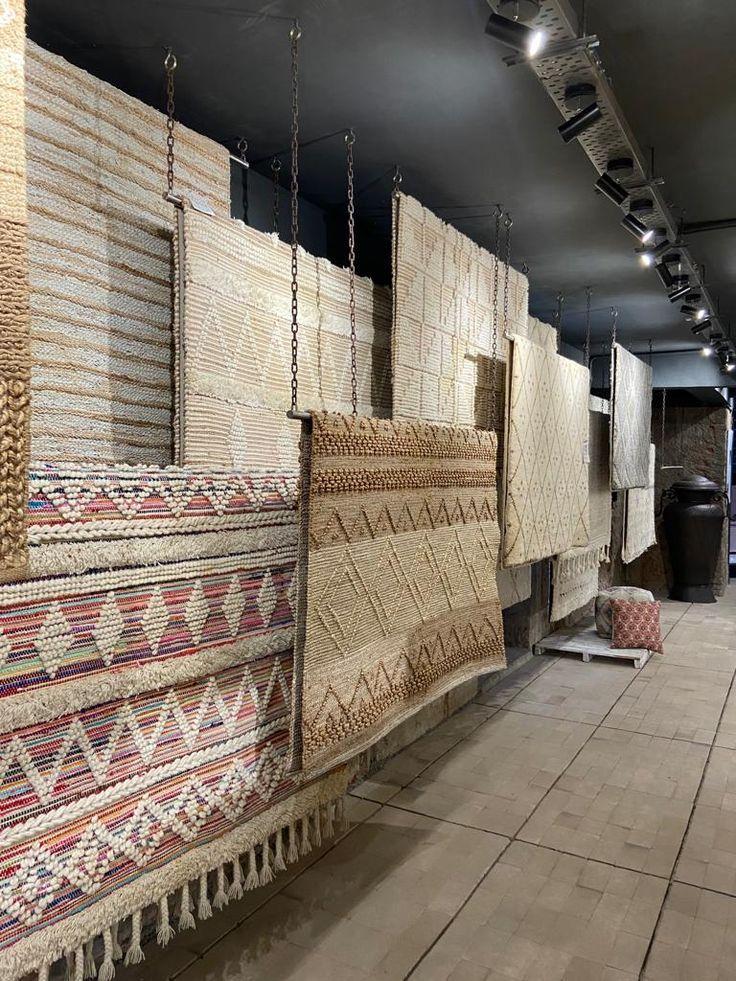
Colour in a rug is not only what the dye provides. The pile height, the weave structure, and the fibre sheen all modulate how a colour reads to the eye. A high pile in a mid-tone camel wool will read warmer and richer than the same colour in a flat-woven dhurrie, because the pile creates micro-shadows that deepen the apparent tone.
Similarly, a silk or bamboo-silk pile reflects light in a way that makes colours appear lighter and more luminous than the same dye on a matte wool surface. This means that two rugs with the same nominal colour can read quite differently in a room depending on their structure. When building a palette, consider the structural properties of the rug alongside the colour, and select companion textiles whose surface quality is compatible.
A deeply pile-textured wool rug reads best alongside other textural surfaces: rough linen, velvet upholstery, natural plaster walls. Smooth surfaces, lacquered furniture, polished stone floors, high-gloss paint, can work as counterpoints but require careful proportion to avoid making the room feel split between two registers. For guidance on specific compositions, our rug process page outlines how structural choices are made in production.
Frequently asked
What if I already have a sofa I love and need to find a rug to work with it?
Start by identifying the undertones in your sofa fabric. Any rug with a field colour that shares those undertones will relate harmoniously. From there, look for rugs whose secondary colours introduce the palette complexity the room needs.
How many colours in a rug are too many for a cohesive room?
There is no absolute limit. A rug with many colours can work in a room where other elements are restrained. The issue is not number of colours but whether the room has a legible hierarchy and enough visual rest.
Should the rug match the curtains?
Not necessarily match, but relate. Both should share tonal family or undertone, or be clearly distinct in a way that is deliberate. Accidental near-matches, where the curtain and rug are close but not the same, tend to look unresolved.
Can a very colourful rug work in a minimalist space?
Yes, provided the surrounding palette is reduced to near-neutrals and the rug is given enough clear floor space to register as an object in its own right. A complex rug in a cluttered room becomes chaotic; the same rug in a spare room becomes the centrepiece.
By RS, 6 November 2025
More in Interiors and Styling.
Follow the journal in Google Search. Readers who add us as a preferred source see our writing marked in Top Stories and in AI Overviews.