Where Bhadohi Is and Why It Matters
Bhadohi is a district in the eastern part of Uttar Pradesh, roughly midway between Varanasi and Allahabad along the Ganga plain. To the uninitiated, it looks like any of dozens of mid-sized district towns in the region: dusty markets, agricultural hinterland, a busy rail junction. Look more carefully and the distinguishing feature becomes apparent. In the villages, workshops, and small family compounds that spread across Bhadohi and the surrounding tehsils of Gopiganj and Aurai, hundreds of thousands of people are engaged in making handmade rugs. The industry is not concentrated in a single factory district but distributed across the social and domestic fabric of the region, woven, quite literally, into its daily life.
Bhadohi's claim to the designation of carpet capital of India rests on production volume, export value, and the depth of the skill concentration in the region. India accounts for a large share of the global handmade rug export market, and the majority of that production originates in and around Bhadohi, supplemented by the related clusters in Mirzapur, Varanasi, and Agra. The Carpet Export Promotion Council (CEPC), the industry body that supports and regulates India's rug export trade, has long had a significant presence in the region, and Bhadohi's reputation is inseparable from India's position in the international rug trade.
For buyers sourcing handmade rugs from India, Bhadohi is not just a place of origin: it is a system. The concentration of weavers, dye masters, wool processors, finishing workshops, and export infrastructure in one region creates efficiencies and quality capabilities that are not replicable by sourcing from dispersed artisan communities. Our about page gives the background on Raheem and Son's roots in this region since 1927.
A Brief History: From Mughal Courts to Global Export
The history of carpet weaving in the Bhadohi-Mirzapur corridor reaches back to the Mughal period, when artisan skills in the eastern Ganga plain were cultivated under imperial patronage. The distinctive Persian-influenced weaving tradition that characterises the region's historic production was introduced and refined over several generations of royal and noble patronage, and the skills accumulated through that period have been transmitted, family to family, workshop to workshop, across the centuries since.
The export dimension of the industry took its modern form in the nineteenth and early twentieth centuries, as British commercial enterprise connected Indian craft production to European and American consumer markets through Calcutta and the port cities. The period between the two world wars saw significant growth in the organised export of Indian rugs, and Bhadohi's position in that trade was established during those decades. By the time of Indian independence in 1947, the region was already the dominant production centre for handmade rug export from the subcontinent.
The second half of the twentieth century brought both expansion and challenge. The post-independence period saw substantial growth in production capacity as international demand for Indian handmade rugs grew, particularly in North America and Europe. The industry also confronted challenges: child labour concerns in the 1980s and 1990s led to international scrutiny and reform efforts that ultimately strengthened the industry's compliance standards. The CEPC's role in setting and promoting quality and documentation standards has been significant in managing the industry's international reputation through these transitions.
The Production Cluster: How Bhadohi Works
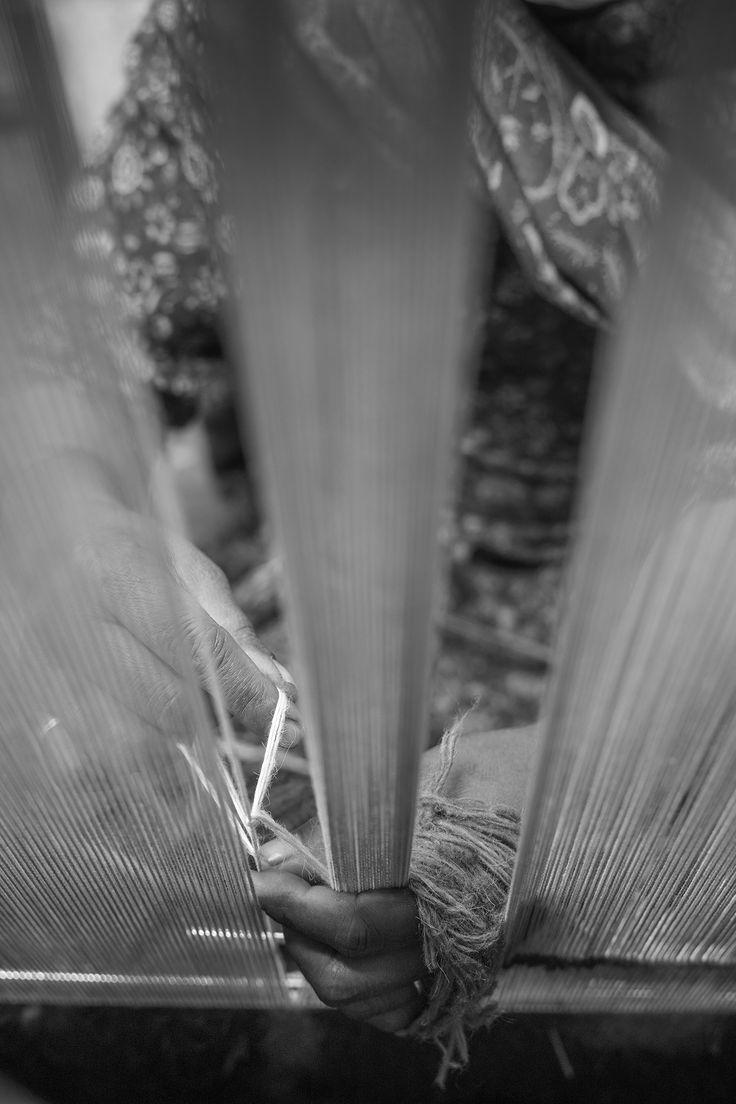
The Bhadohi production cluster operates through a distributed network rather than through centralised factory production. At its core are the weavers, who work on pit looms or frame looms, mostly in their own homes or in small family workshops. A typical family weaving unit might have two to four looms operated by multiple household members across the working day. The weaving family is connected to the wider trade through an intermediary known locally as a karigar or contractor, who provides design instruction, yarn, and a mechanism for the finished pieces to reach the exporter.
Above the karigar level sit the larger exporter-manufacturers, companies with significant loom networks, their own dye operations, quality control infrastructure, and export capability. Raheem and Son is one of the larger such operations in the region, with over 1,400 looms and a workforce of more than 6,000 weavers. At this scale, the company can take responsibility for the full production chain from fibre sourcing to finished export, maintaining quality consistency across a large and distributed production base.
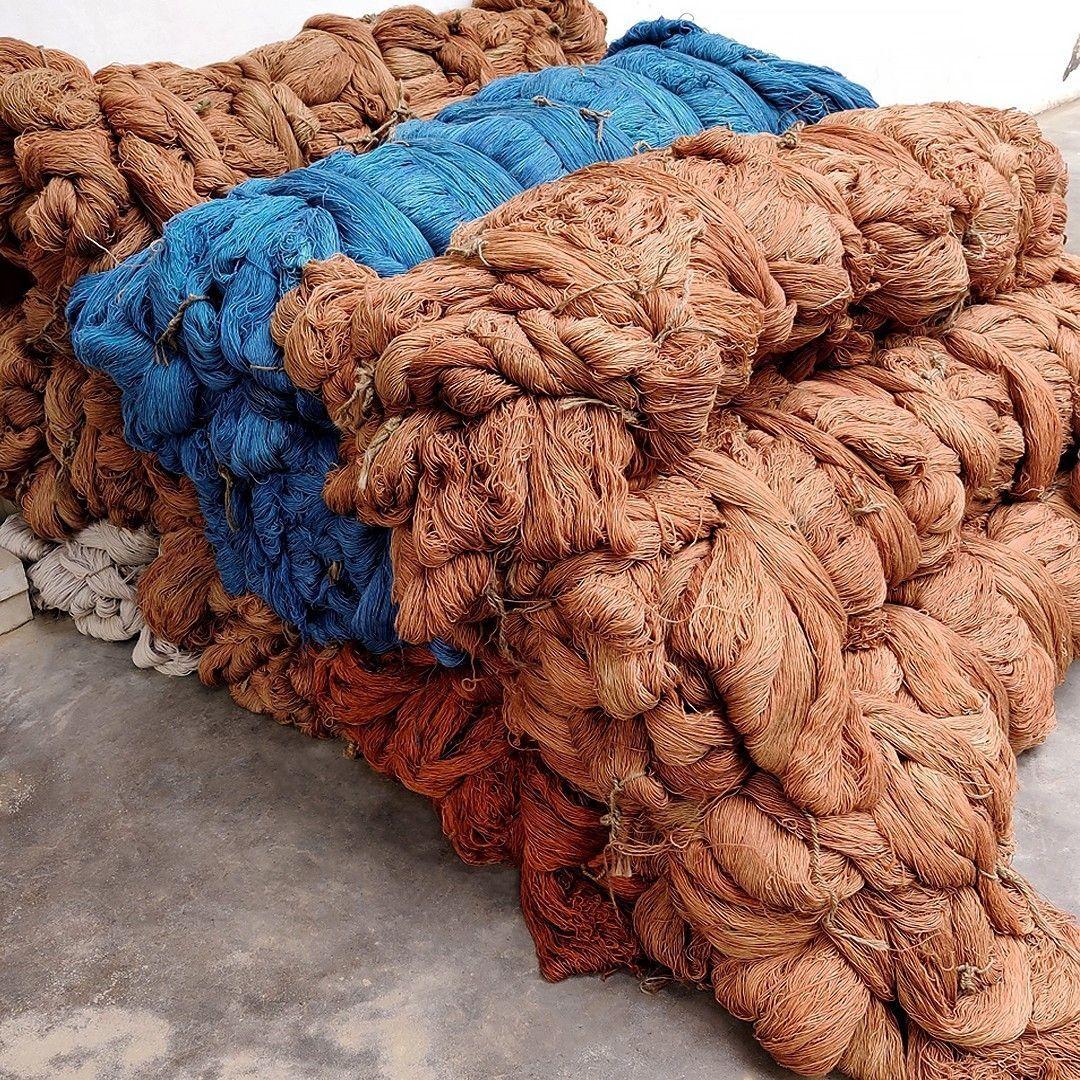
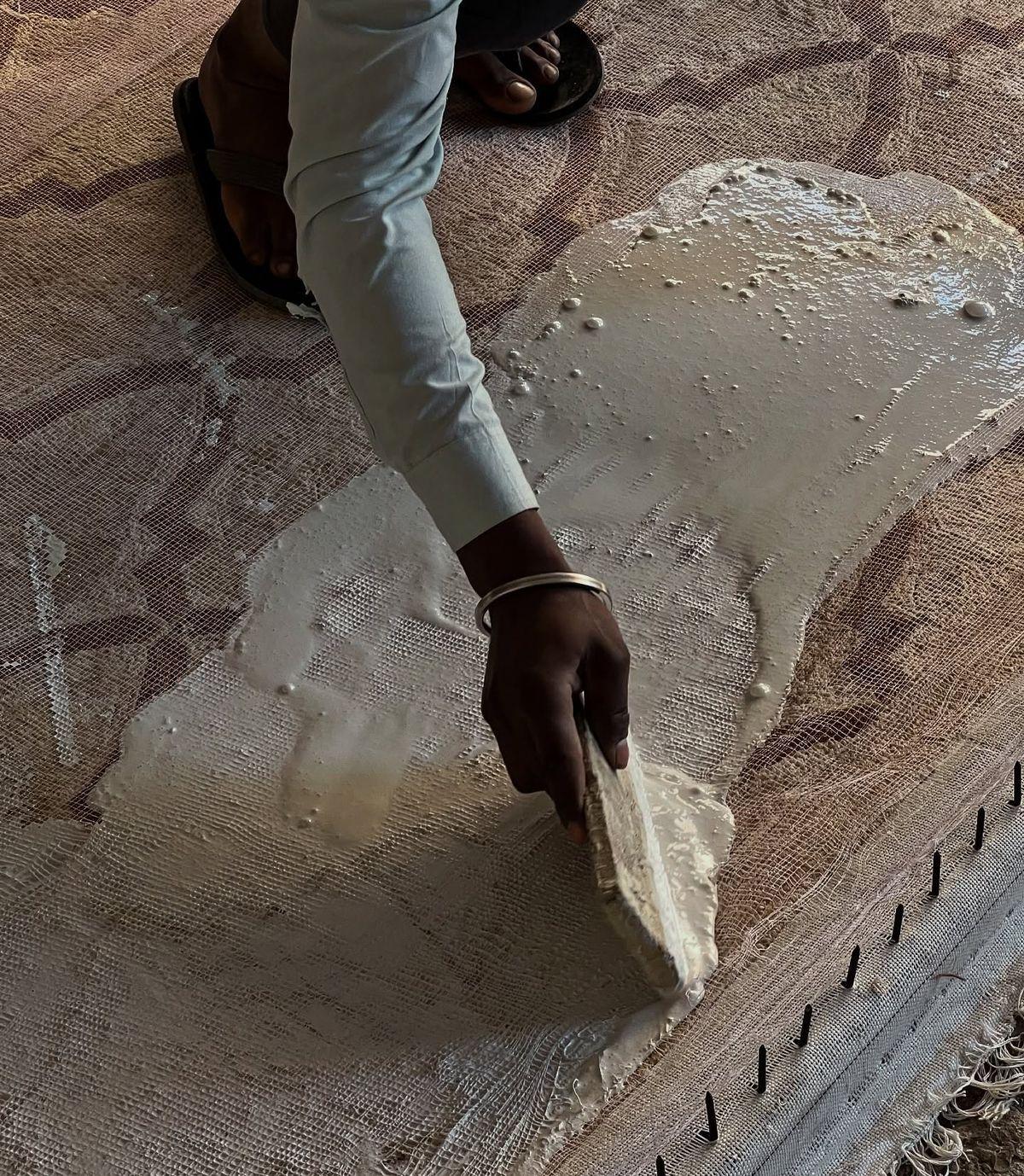
The dye houses and washing ghats of Bhadohi are as important to the production system as the looms. The finishing of a handmade rug, the washing, blocking, stretching, and final clipping that transforms a raw-woven piece into a saleable product, requires scale and expertise that family workshops cannot provide individually. Specialist finishing operations serving multiple weaving producers are a key part of the cluster's infrastructure.
The Craft Skills of Bhadohi: What Is Actually Being Preserved
The phrase craft skill, used in relation to handmade rug production, encompasses several distinct competencies that are individually transferable and collectively irreplaceable. The most visible is the weaving skill itself: the speed, consistency, and precision with which an experienced weaver ties knots and maintains pile height across a large piece. A master weaver in Bhadohi can tie thousands of knots per day with a consistency of tension and pile height that makes the finished surface appear machine-perfect, while carrying design complexity that only hand production can achieve.
Less visible but equally important are the skills of the dyemaster and the design reader. The dyemaster's ability to reproduce a colour precisely across multiple dye batches, to adjust for variations in fibre lot and water quality, and to develop new colourways from a digital reference is a skill acquired over many years of practice. The design reader's ability to translate a cartoon or graph paper design into loom instructions and then into a woven pattern without deviation is the skill that makes complex designs producible at scale.
These skills are transmitted primarily through apprenticeship and family tradition. A child born into a weaving family in Bhadohi absorbs the craft from early observation, and formal training reinforces and extends what has been informally absorbed. The concentration of craft in the region means that the skills do not need to be taught from first principles in each generation; they are the ambient knowledge of the community. This is the meaning of a craft cluster that is not easily replicated in regions without the same depth of tradition.
Economic Scale: What the Industry Means for the Region
The carpet industry is the primary economic engine of the Bhadohi region. It supports not only weavers but the entire support economy that sustains them: yarn merchants, dye suppliers, loom carpenters, transport operators, finishing workers, quality inspectors, and the service businesses that cater to a working population of several hundred thousand people engaged directly or indirectly in the trade.
The industry's dependence on export markets means that global economic conditions and international trade policy have direct effects on the livelihoods of weavers in rural Bhadohi. Currency fluctuation, import duty changes in destination markets, and shifts in consumer preference all filter through the export order book to the workshop floor within months. This sensitivity is a structural feature of export-oriented craft production, and it is one reason why the long-term relationships between established exporters and their weaving communities matter so much. Stability in the buyer relationship translates into stability in the weaving household.
Raheem and Son's commitment to the region since 1927 reflects an understanding of this interdependence. Our manufacturing page provides more detail on our production infrastructure and the standards we maintain across our weaving network.
Visiting Bhadohi: What Buyers and Designers Should Know
Buying visits to Bhadohi provide a dimension of understanding that no digital catalogue or sample box can replicate. Seeing a loom room in operation, watching a dyemaster adjust a batch, and inspecting a washing ghat full of rugs drying in the sun gives buyers the context that makes specifications, lead times, and quality discussions meaningful. Most established exporters in the region welcome buyer visits and can arrange factory tours as part of a sourcing trip.
Practical logistics for a Bhadohi visit typically involve flying into Varanasi (VNS), which is the nearest commercial airport, and travelling by road to Bhadohi, a journey of approximately 60 kilometres. Varanasi has good hotel infrastructure for international visitors. Most exporters can arrange factory transport and introductions to the production facilities on request.
For buyers who cannot visit in person, a structured video facility tour conducted by our production team is an effective substitute. We have provided virtual visits for accounts in North America, Europe, and Australia as part of the initial supplier evaluation process. Contact our team through the about page to arrange either an in-person or virtual visit.
Frequently asked
Why is Bhadohi considered the carpet capital of India?
Bhadohi and the surrounding Mirzapur region produce the largest share of India's handmade rug exports by volume and value, and the concentration of weaving skills, dye houses, finishing workshops, and export infrastructure in the area is unmatched in the country. The depth of craft tradition, spanning several generations of continuous production, further supports the designation.
How many people work in the Bhadohi carpet industry?
Estimates of the total workforce, including weavers, support trades, and ancillary services, run into the hundreds of thousands across the district and surrounding region. The industry is the primary source of formal and informal employment for a large proportion of the region's population.
Is it possible to visit rug manufacturers in Bhadohi?
Yes. Most established exporters welcome buyer and designer visits. The nearest commercial airport is Varanasi, approximately 60 kilometres from Bhadohi. Factory tours can be arranged through the exporter in advance of a visit. Contact Raheem and Son through our about page to arrange a visit or a virtual tour.
What role does the CEPC play in Bhadohi's rug industry?
The Carpet Export Promotion Council (CEPC) is an Indian government-supported body that promotes the export of Indian rugs and carpets, sets quality and documentation standards, supports industry training, and represents the industry's interests in trade policy discussions. CEPC registration requires manufacturers to meet defined documentation and quality standards relevant to international export.
By RS, 4 June 2026
More in Heritage and Sustainability.
Follow the journal in Google Search. Readers who add us as a preferred source see our writing marked in Top Stories and in AI Overviews.