Why Rug Size Is the Decision That Changes Everything Else
A rug that is correctly sized for a room anchors the furniture grouping, defines the spatial zone, and reads as a considered design decision. A rug that is too small makes the furniture look untethered and the space feel disconnected. A rug that is too large crowds the room and competes with the architecture. Yet rug sizing is one of the most frequently misjudged decisions in interior furnishing, in both residential and commercial contexts.
The challenge is that the intuitive choice, ordering the size that seems approximately right from a photograph or floor plan, is systematically biased toward smaller than needed. Rugs look larger on a warehouse or showroom floor without furniture; they look smaller once surrounded by sofas, dining chairs, and floor lamps. The practical result is that most rooms would benefit from a rug one size larger than the buyer initially considers. Our size-and-fitting-guide provides a detailed reference for the most common room types, and the principles in this article give the underlying rationale.
This guide covers the most common interior configurations: the living room seating grouping, the dining table arrangement, the bedroom, and the corridor or hallway. Commercial sizing is addressed separately in the final section. The rules are not rigid; they are practical starting points that experienced designers adjust for specific spatial conditions.
Living Room: How to Size a Rug for a Seating Grouping
The living room is where rug sizing most directly affects the perception of the space. The primary question is whether the rug should sit under the front legs of all seating, all legs of all seating, or only the coffee table. Each approach produces a different spatial result.
The most common and visually robust approach for a standard rectangular living room is to size the rug so that the front legs of all sofas and chairs in the grouping rest on it, with approximately 15 to 20 cm of rug visible beyond the front legs. This creates a cohesive zone that reads clearly as a seating area without requiring the rug to extend under the full depth of heavy furniture. A 240x300 cm or 270x370 cm rug is typically appropriate for a four-seater sofa arrangement in a medium-sized living room.
In open-plan settings, the rug's size takes on additional importance as the primary spatial divider between the living and dining or cooking zones. In this context, sizing up rather than down is almost always the correct decision. A rug that is clearly large enough to define the living zone reads as intentional; one that appears barely adequate looks like a compromise. Our collections include multiple sizes within each construction and pattern, and our team can advise on size availability for any specific design.
Dining Room: Sizing Around a Table and Chairs
Dining room sizing is governed by a single practical requirement: when chairs are pulled out for seating, all four legs of each chair must remain on the rug. This prevents the scraping and tipping that occur when rear chair legs drop off a rug edge, and ensures that the rug reads as a coherent platform rather than an object that the dining set is partially sitting on.
The rule of thumb is to add approximately 60 to 70 cm to each dimension of the table to arrive at the minimum rug size. A 180 cm round dining table needs a rug of at least 300 cm diameter. A 90x200 cm rectangular table needs a rug of at least 210x320 cm to satisfy the pull-out-chair requirement. In practice, going 10 to 20 cm larger than the minimum is wise because it accounts for non-standard chair designs, tables that extend with leaves, and the visual comfort that comes from a rug with a generous margin.
Round rugs in dining rooms can work well under round tables but require more precise placement than rectangular rugs, as any off-centre positioning is immediately visible. For rectangular dining tables, a rectangular rug is almost always the more practical choice. Confirm the nominated dining rug size in context by taping out the dimensions on the actual floor before ordering.
Bedroom: Sizing Options and the Half-Under Approach
Bedroom rug sizing offers more flexibility than living or dining rooms because the primary functional requirement is tactile, not spatial: the rug should provide a warm surface underfoot when stepping out of bed in the morning. The standard approach for a double, queen, or king bed is to run the rug under the lower two thirds of the bed so that approximately 50 to 60 cm of rug extends beyond each side and at the foot.
For a standard UK king-size bed (150x200 cm), a 200x300 cm rug placed so that 50 cm extends on each side and 70 cm at the foot produces the proportional balance that most rooms require. For larger beds or rooms with additional seating, scale up accordingly. The alternative approach, placing two runner rugs on each side of the bed rather than one large rug under it, is practical in rooms where the bed is close to a wall and a full-size rug would extend only on one side.
Children's rooms and teenager spaces sometimes work better with a rug sized to define a play or study zone rather than anchored to the bed. In this case, the rug size should be proportional to the zone it defines rather than the bed it may or may not partially sit under. A 150x200 cm or 160x230 cm rug in a children's room defines a reading and play area effectively without dominating the room.
Corridors, Hallways, and Stair Runners: The Long-Format Consideration
Runners for corridors and hallways follow a different sizing logic from area rugs. The runner width should relate to the corridor width rather than the furniture arrangement: a runner that spans 60 to 70 percent of the corridor width typically looks best, leaving a consistent margin of bare floor on each side. Too narrow a runner in a wide corridor looks lost; a runner that spans the full corridor width loses its definition as a separate element.
For stair runners, the practical considerations of safety and wear life are as important as aesthetics. A stair runner should be wide enough to cover the primary traffic zone of the stair without extending to the wall brackets, and should be installed with appropriate gripper tape or rods at each tread. Wool pile runners are the most appropriate choice for stairs because they compress and recover well under foot impact. Our size-and-fitting-guide includes specific guidance for stair runner sizing and installation.
Commercial Sizing: Offices, Hospitality, and Retail Environments
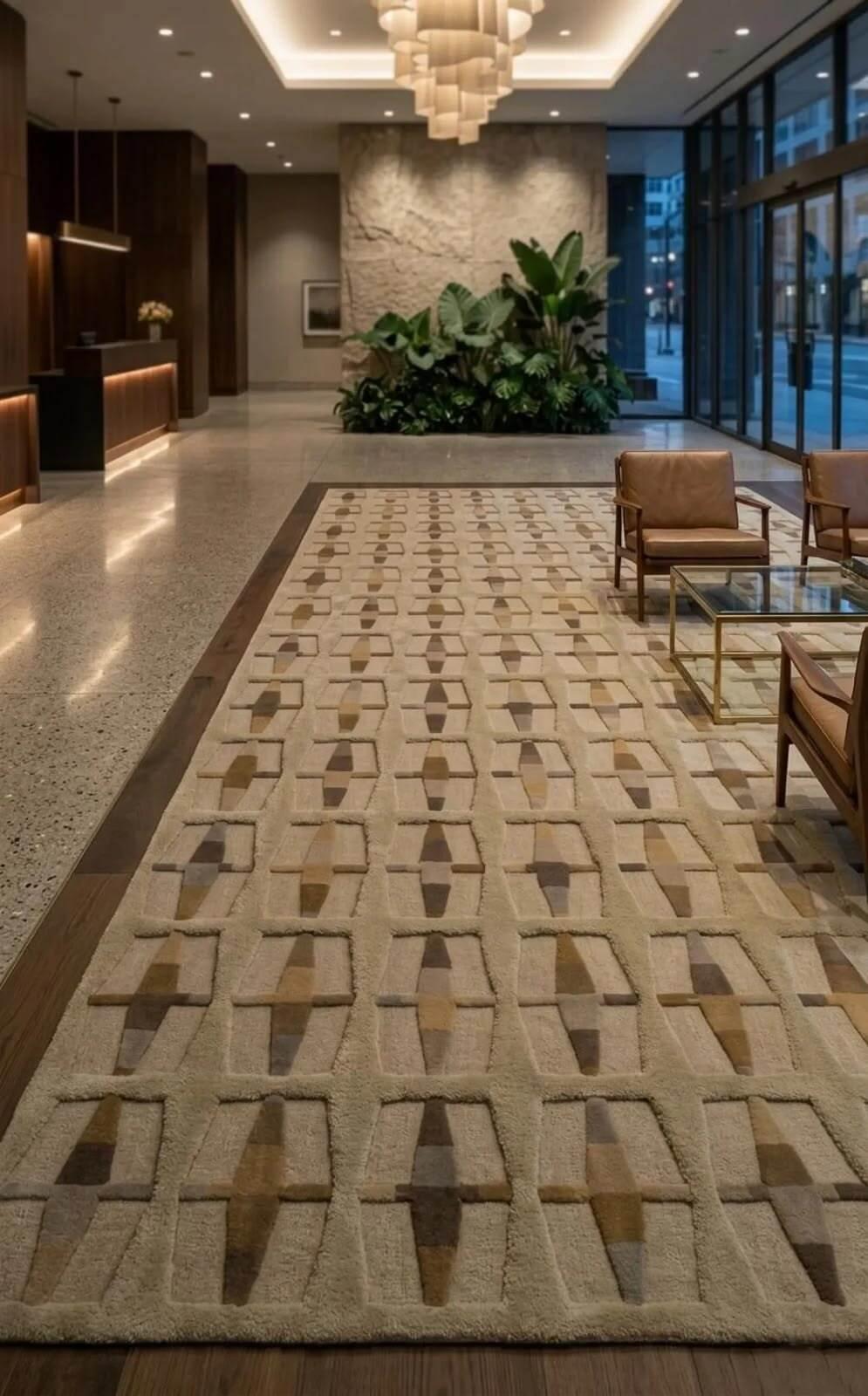
Commercial sizing decisions are more variable than residential ones because the spaces are more varied: hotel lobbies, open-plan offices, restaurant dining rooms, retail boutiques, and healthcare reception areas all have different spatial geometries and different functional requirements for the floor covering.
The starting point for commercial sizing is the architectural plan. Overlay the rug footprint on the plan at scale and assess whether the proposed size defines the intended zone clearly, whether it creates any trip hazards at doorways or circulation routes, and whether it accommodates the furniture layout in its standard and reconfigured forms. For large commercial projects, it is worth commissioning a full-scale floor tape mockup before committing to rug production, particularly if the rug is a bespoke size. Raheem and Son can produce rugs to custom dimensions with tolerances of plus or minus two to three percent, which accommodates most architectural fitting requirements.
In office environments, area rugs under seating groups should be sized to encompass the full chair movement zone, not just the chair footprint at rest. A seating cluster where chairs roll back during meetings requires a rug large enough to keep all wheels on the rug throughout the movement range. In retail, rug size should define the browsing zone clearly without obstructing the primary circulation route through the space. If in doubt about commercial sizing, our team is happy to review floor plans and advise on appropriate rug dimensions.
Frequently asked
What is the most common rug sizing mistake buyers and consumers make?
The most common mistake is choosing a rug that is too small for the space. Rugs look larger in isolation than in context, and buyers consistently underestimate the size needed to anchor a furniture grouping or define a spatial zone. When in doubt, size up to the next standard dimension.
Should a rug go under the sofa or just under the front legs?
Either approach can work, but the most common and visually effective option for a standard seating grouping is to position the rug so that the front legs of the sofa and chairs rest on it. This anchors the furniture to the rug without requiring the rug to extend under the full depth of heavy pieces.
Can handmade rugs be ordered in custom sizes?
Yes. We produce handmade rugs to custom dimensions without a premium on the size itself, though custom loom set-ups may add to the lead time for very non-standard widths. Share your required dimensions with our team and we will confirm production feasibility and lead time.
How much space should there be between the rug edge and the wall?
A common guideline is 30 to 50 cm of bare floor between the rug edge and the wall in a standard residential room. This margin defines the rug as a deliberate element rather than a wall-to-wall floor covering and allows the floor material to frame the rug. In smaller rooms, this margin can be reduced; in very large open-plan spaces, more bare floor around the rug can improve spatial legibility.
By RS, 10 June 2026
More in Materials and Construction.
Follow the journal in Google Search. Readers who add us as a preferred source see our writing marked in Top Stories and in AI Overviews.