Why Texture Matters More Than Colour in Neutral Rooms
When a room's palette is built around warm neutrals, the eye has nowhere to rest on contrast. It looks instead for depth, and depth in a neutral interior comes almost entirely from texture. The difference between a flat beige room and a layered one is the presence of materials that catch light differently: a nubbled wool pile, a burnished leather surface, a raw linen sofa. Without textural variation, neutrals flatten into monotony.
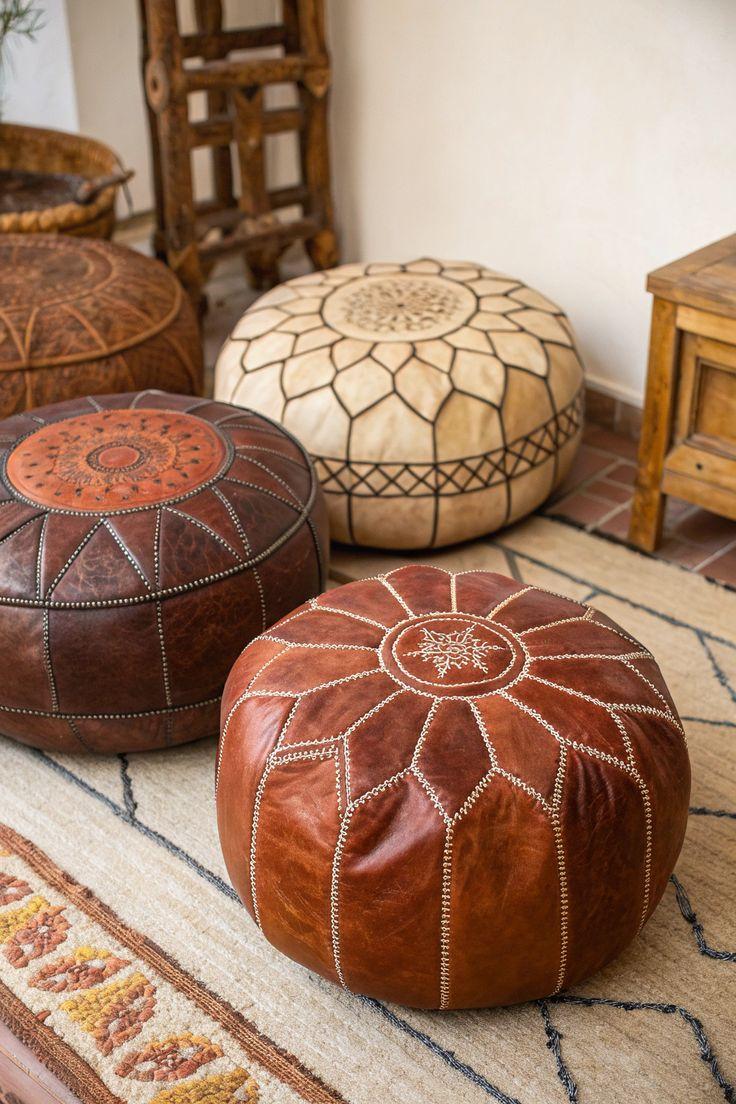
Leather poufs occupy a particular role in this layering because they carry two textures at once. The outer surface, whether smooth full-grain or subtly distressed, reflects light in a directional way, while the stitching and seaming introduce linear rhythm. Place a leather pouf beside a hand-knotted wool rug with a cut pile, and the two surfaces enter a dialogue, one matte and dimensional, the other taut and reflective.
The principle applies equally in residential and hospitality settings. Browse our collections to see how undyed and lightly toned handmade rugs provide an ideal base layer for rooms that rely on tactile contrast rather than colour drama.
The Warm Neutral Family: Tones That Earn Their Place
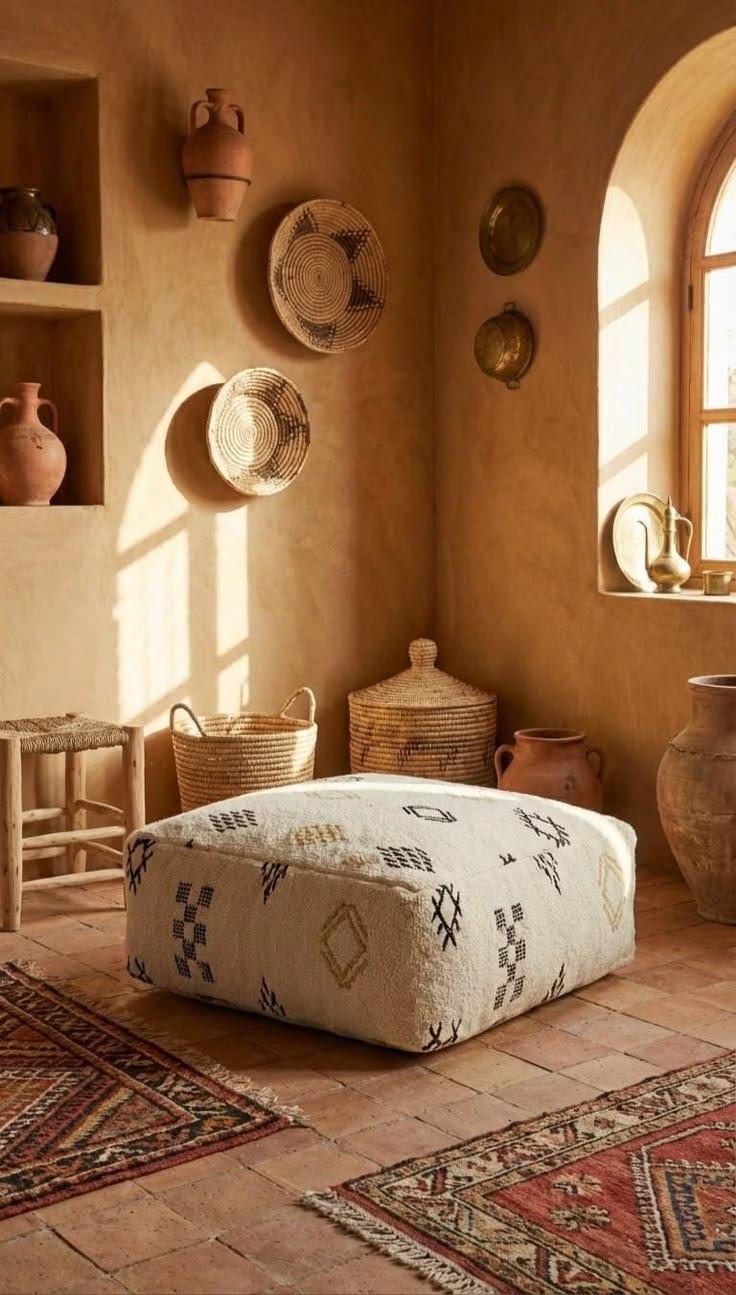
Warm neutrals span a range that includes ivory, undyed natural wool, sand, terracotta-adjacent beiges, warm taupe, and dusty rose-grey. What distinguishes them from cool neutrals is the presence of yellow, red, or orange undertones. These undertones make a room feel inhabited rather than clinical, and they interact well with the natural tonal variation present in vegetable-dyed or undyed handmade rugs.
Leather, when left natural or dyed in traditional earth tones, sits comfortably within this family. Tan, cognac, raw sienna, and warm chocolate are all tones that recur in the natural world and in artisan craft traditions across Central Asia, North Africa, and South Asia. A cognac pouf placed on a sand-coloured hand-knotted rug creates a composition that feels assembled over time rather than purchased as a set.
Avoid over-matching. When the pouf tone is identical to the rug's ground colour, the pouf disappears. Choose a tone that is one to two steps warmer or deeper than the rug's dominant field, so each piece reads clearly without competing.
Placement and Proportion: Getting the Relationship Right
A pouf's relationship to the rug beneath it is fundamentally spatial. If the rug is large enough, the pouf sits within it and becomes part of the floor composition. If the rug is more modestly sized, the pouf may straddle the edge or sit just beyond, which can work if the floor material beneath is warm in tone and simple in texture.
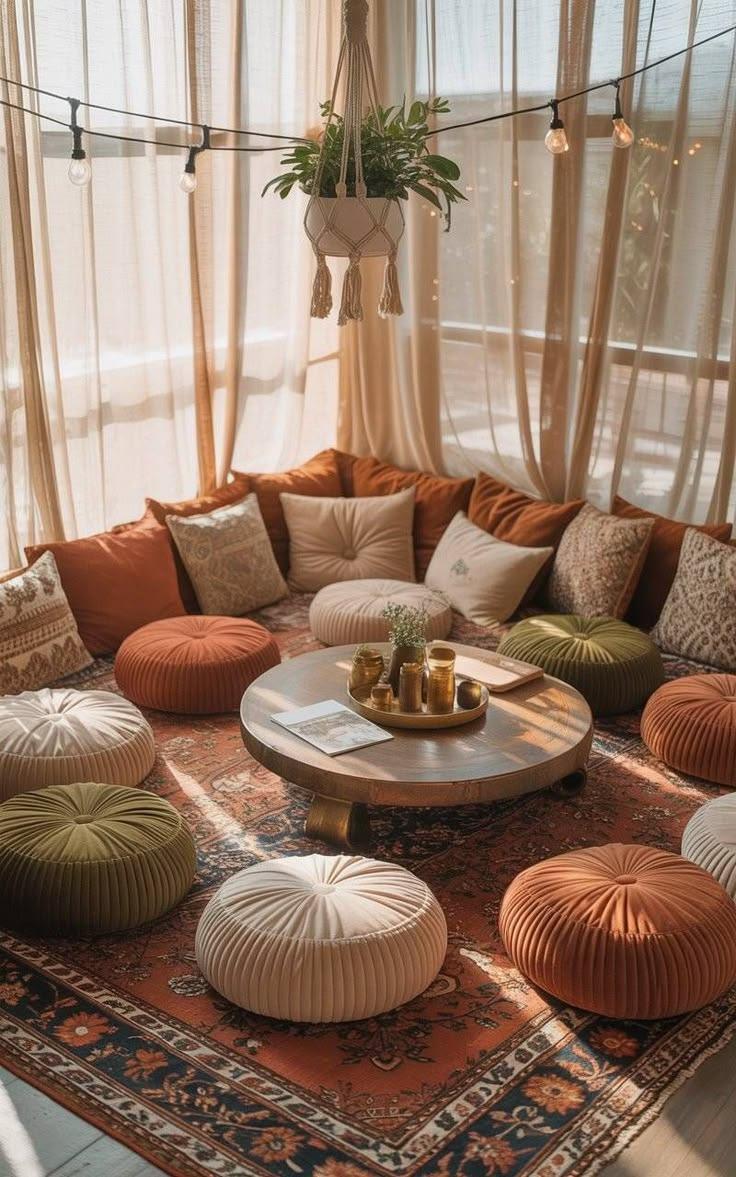
As a rough guide, the pouf base should occupy no more than roughly a sixth of the rug's surface area, leaving the pattern and pile visible. Multiple poufs work well in a cluster when the rug is large, particularly in a reading corner or around a low coffee table. In those arrangements, vary the pouf sizes slightly rather than using identical pieces, which reads as more considered and less catalogue-like.
Consult our size and fitting guide when planning the rug dimensions beneath a floor-seating arrangement. The guide covers typical clearance distances and how to anchor furniture groupings on a rug without the composition feeling crowded.
Material Pairing Logic: Wool, Silk, and Leather Together
Leather and wool are natural companions because both are animal fibres processed by hand into durable goods. Their tactile contrast is pronounced: leather is smooth, cool to the first touch, and warms quickly to body temperature; wool is insulating from the first contact, yielding underfoot, and visually soft. Together they read as instinctively natural in a way that synthetic materials do not replicate.
Where silk enters a rug, the pairing with leather shifts slightly. Silk pile catches light with an intensity that can make a leather surface look dull by comparison. In those compositions, place the pouf at the rug's edge rather than over the silk sections, so both materials have space to register. Alternatively, choose a leather with a burnished or embossed surface that introduces its own light-catching quality.
For rooms with jute or flat-woven rugs, leather poufs provide the soft form that the rug itself cannot offer underfoot. See our notes on jute and natural-fibre rugs for guidance on which base materials benefit most from the addition of upholstered accessories.
Care Considerations When Leather and Rugs Share a Space
The underside of most leather poufs is fitted with a leather or suede base. On hand-knotted pile rugs, this base can compress the pile over time if the pouf sits in a fixed position for months. A simple practice is to rotate the pouf's placement every few weeks, and periodically lift it to allow the pile to recover. On flat-woven or kilim rugs, compression is less of a concern, though the pouf base can trap dust and moisture if left in place through seasonal humidity changes.
Leather surfaces benefit from occasional conditioning, particularly in dry climates. Keep leather conditioners away from the rug pile; even a small amount of oil or wax can darken wool fibres and attract dust. Apply any leather care products with the pouf placed off the rug, and allow it to dry fully before returning it to position.
Visit our care and cleaning guidance for a full overview of rug maintenance, including how to handle accidental transfer of oils or conditioners onto wool pile.
Sourcing Leather Poufs That Match the Quality of a Fine Rug
A hand-knotted rug made from hand-spun wool and natural dyes represents a significant material investment. Pairing it with a poorly constructed pouf, one where the leather is thin-grade and the filling is loosely packed, undermines the visual quality of the entire room. The pouf need not be expensive in absolute terms, but its construction and material should be honest.
Look for poufs made from full-grain or top-grain leather, stitched with waxed thread, and filled with recycled cotton or natural fibre rather than synthetic foam. Traditional Moroccan leather poufs, made in Fez or Marrakech, are often filled with dried alfa grass or shredded natural fibre and carry an irregular, lived-in silhouette that pairs naturally with hand-knotted rugs. Indian leather poufs from artisan workshops in Rajasthan follow a similarly traditional construction.
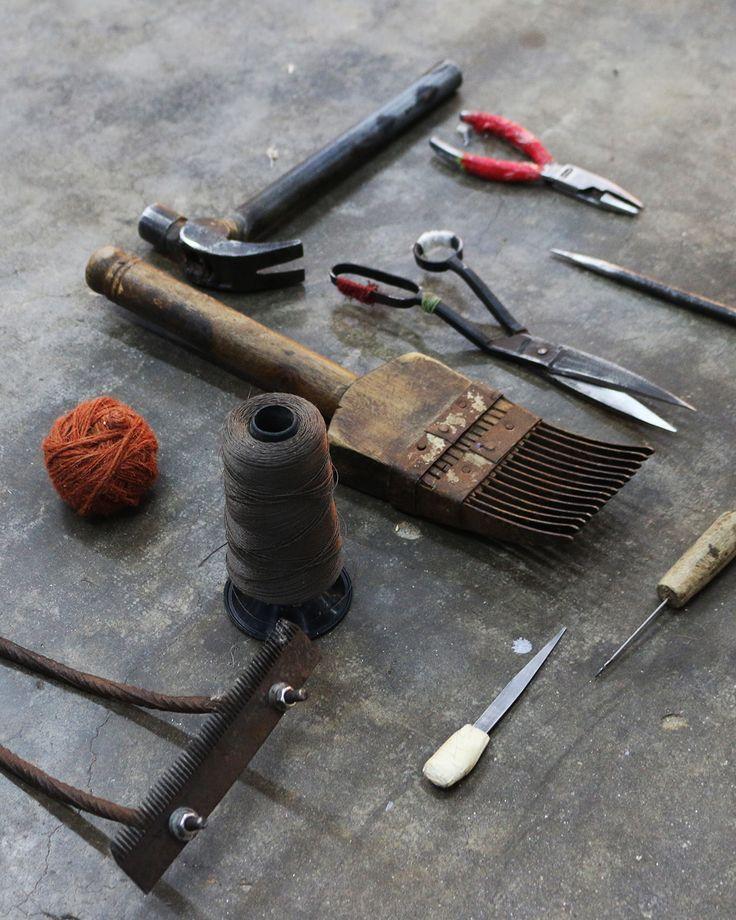
When in doubt, ask your supplier for the leather grade, the origin of the hide, and the filling material. These three questions separate craft goods from commodity goods, the same way knot count, fibre quality, and dye source separate a fine rug from a machine-made approximation.
Frequently asked
Can a leather pouf be placed on a silk rug without damaging it?
It is generally fine to place a pouf on a silk or part-silk rug, provided the base is smooth and clean. Avoid poufs with rubber-tipped feet, which can leave marks. Rotate the position periodically to prevent pile compression.
What neutral rug tones work best under a cognac leather pouf?
Sand, ivory, warm taupe, and light camel tones work well. The pouf colour should be visibly distinct from the rug's ground colour so each piece reads clearly. Avoid an exact colour match, which causes the pouf to visually disappear.
How do I layer multiple floor accessories without the composition looking cluttered?
Vary the heights and textures: a low pouf, a flat tray on the rug, and a slightly taller side table create hierarchy. Keep the rug's pattern visible by leaving clear areas of pile between accessories.
Are leather poufs suitable in high-humidity rooms?
Leather can absorb moisture in humid environments, which may cause stiffening or mildew over time. In humid climates, choose well-tanned leather and ensure good air circulation around the piece. Condition the leather seasonally with a product suited to the tannage.
By RS, 4 September 2025
More in Interiors and Styling.
Follow the journal in Google Search. Readers who add us as a preferred source see our writing marked in Top Stories and in AI Overviews.