Handmade vs machine-made rugs: two different products
A handmade rug is made by a person, knot by knot, tuft by tuft or pass by pass, on a loom or a frame. A machine-made rug is produced on a power loom or a tufting machine, in a factory, at speed. Both are real rugs. They differ in how they are made, how they last, what they can do with design, and what they ask of the buyer.
We make handmade rugs, so we have a point of view, but a fair comparison needs to admit what machines do well. This guide sets out the differences, then gives a verdict by use case. For a closer look at handmade construction types, see hand-knotted vs tufted vs woven.
How the two are made
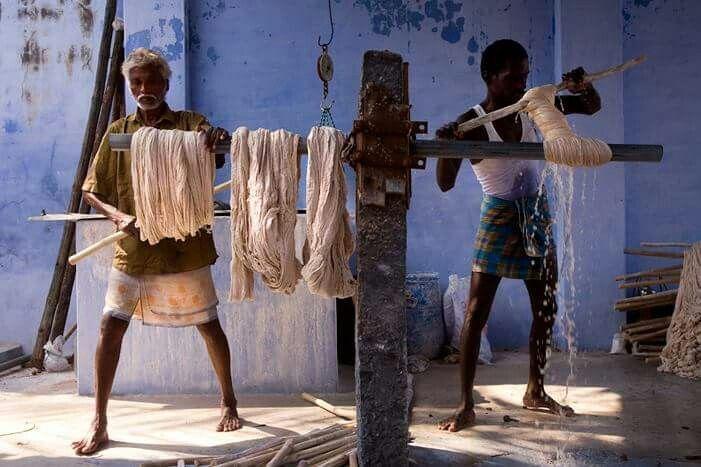
Handmade rugs include hand-knotted, handloom, hand-tufted and flatweave constructions. A hand-knotted rug is built knot by knot on a loom with the pile tied into the foundation, which our weaving page notes means no glue or backing and the potential to last for generations. The slow, hand-made process is shown on our process page.
A machine-made rug is woven or tufted by a machine from a programmed pattern. The result is uniform and consistent, and large quantities can be produced quickly. The same machine can repeat a pattern thousands of times with little variation, which is both its strength and its limit.
| Factor | Handmade | Machine-made |
|---|---|---|
| Made by | Weavers and artisans | Power loom or tufting machine |
| Consistency | Small natural variation between pieces | Highly uniform |
| Speed | Slow; sampling and production take weeks | Fast, with high volume |
| Design freedom | Custom size, colour and pattern possible | Limited to what the machine and set-up allow |
| Lifespan | Can be very long, especially hand-knotted | Varies; usually shorter |
| Repair | Often repairable by hand | Harder to repair well |
| Cost | Higher, due to labour | Lower, due to speed and scale |
| Typical fit | Heirloom, luxury, bespoke and hospitality | Budget, short-term and high-volume use |
How to tell them apart
Turn the rug over. On a hand-knotted rug the pattern shows clearly on the back, with the knots visible as small, slightly irregular dots. A hand-tufted rug usually has a cloth backing, often with glue. A machine-made rug often shows very regular rows and a dense, uniform back, and the fringe may be sewn on rather than being a continuation of the warp.
Look at the edges and the pattern. Slight irregularities in line, a small colour change from one dye batch, or an uneven row are typical of handwork. Perfect symmetry down to the last row suggests a machine. These are guides, not proof, so ask the seller what the construction is and request it in writing. Our guide to knot density explains how to read a handmade rug's back.
Durability, repair and long-term value
Durability depends on the fibre as well as the method. A machine-made wool rug can outlast a poorly made handmade rug. But a well-made hand-knotted rug has a structural advantage, because the pile is part of the foundation and can be repaired, washed and re-fringed over many years. A tufted rug has a glued backing, and a machine-made rug may use synthetic fibres that do not recover from crushing.
For a client who wants something to last, handmade is the more defensible choice. For a short-term fit-out, a rental, or a sacrificial surface like an event space, machine-made may be the more rational one. Our heirloom buying guide goes deeper on long-term value.
Design freedom and custom work
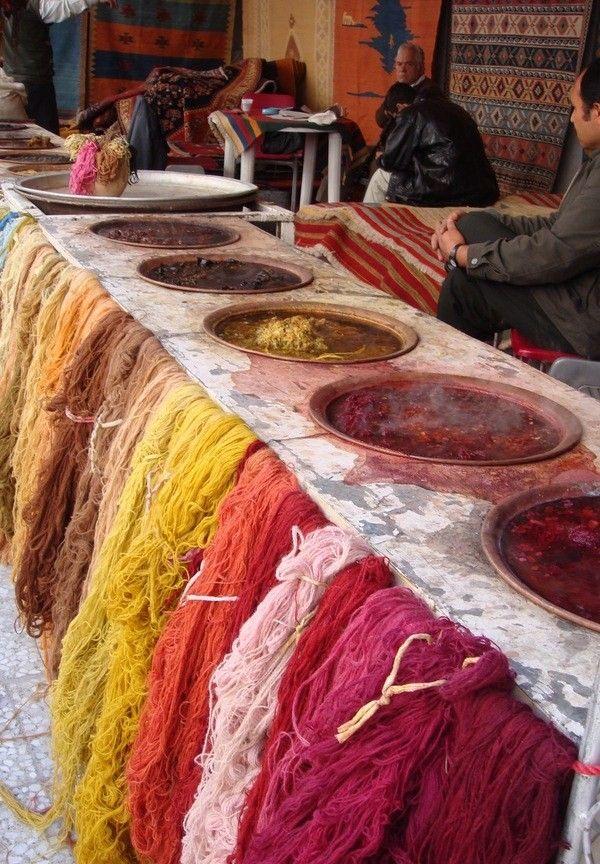
This is where handmade has the clearest edge. A handmade rug can be made in any size, in a colour dyed to match a reference and in a design drawn for the room. Our rug process page shows how the work moves from fibre to finish, and our sample programme lets you check colour and hand before an order.
A machine is efficient with standard sizes and designs but expensive and inflexible for one-offs. If your project needs a non-standard size, a precise colour match or a cut-out, handmade is usually easier to adapt.
What the price difference really pays for
A handmade rug costs more mainly because of labour. Weavers spend many hours on each piece, and a finer density takes longer again. A machine-made rug spreads its cost across a high volume, so the price per piece falls. We do not publish prices or ratios, because they depend on construction, fibre and size, but it helps to see what the difference buys.
It buys time spent by a person who can see and correct the work, a foundation that can be repaired, the ability to change size, colour and design for one order, and, for some constructions, a very long life. It does not automatically buy better fibre or better design, so look at the specification and not only the method.
It also buys variation. A handmade rug carries small irregularities that are part of its character, and a buyer who wants perfect uniformity may be happier with a machine-made one. Neither is a defect, but they are different expectations, and it is better to know which one you have.
Questions to ask before you buy either
Ask how the rug was made, and ask the seller to state it in writing. Ask what the fibre content is, as a percentage, and what the backing is. Ask about the pile height and density. Ask what the return, repair and care options are.
For a handmade rug, ask whether it can be sampled and whether size and colour can be adapted. For a machine-made rug, ask what the standard sizes are and how consistent the colour is between batches.
For a project, ask what documentation exists. We are plain about this on our standards page, and a supplier of either kind should be too.
Verdict by use case
Choose handmade for luxury residential, hospitality lobbies and suites, bespoke commissions, heirloom pieces and any project where custom size, colour or lasting value matters.
Choose machine-made for tight budgets, short-term spaces, high-volume standard sizes and areas where replacement is expected.
Whichever you choose, ask for the construction and fibre in writing. If you are weighing handmade options, request samples and send your brief via the bulk quote form. See also our wholesale rug buying guide.
Frequently asked
Are handmade rugs worth the extra cost?
Where longevity, repairability and design freedom matter, usually yes. Where the rug is a short-term or low-budget item, a machine-made rug may be the more sensible choice.
How can I tell if a rug is handmade?
Check the back. A hand-knotted rug shows its pattern clearly with slightly irregular knots. A tufted rug usually has a cloth backing. A machine-made rug shows very regular rows. If in doubt, ask the seller for the construction in writing.
Is a hand-tufted rug handmade?
Yes, it is made by hand with a tufting gun on a frame, but it is a different construction from hand-knotted and generally less durable. See our comparison of hand-knotted and hand-tufted rugs for the details.
Can handmade rugs be made in a custom size?
Yes. Custom size, colour and design are among the main advantages of handmade work. Send the specification and we will quote per project.
By Raheem & Son Editorial Desk, 12 October 2026
Written with the production and export teams in Bhadohi, where Raheem & Son has made rugs since 1927. See about the house and how we manufacture. Read our editorial policy.
More in Materials and Construction.
Follow the journal in Google Search. Readers who add us as a preferred source see our writing marked in Top Stories and in AI Overviews.