Dhurrie vs kilim: the short answer
Dhurrie and kilim are both flatwoven rugs with no pile. The word dhurrie is used for the flatweaves of the Indian subcontinent, and kilim is used for flatweaves from Turkey, Iran, the Caucasus, Central Asia and North Africa, among other places. The two overlap in technique, which is why they are so often confused, but they differ in tradition, typical design language and, often, in how the weave is built.
This guide explains the differences as plainly as we can, without claiming more certainty than the history allows. Terms in this trade are used loosely, and different sellers draw the line in different places. If you are writing a spec or buying for resale, the safest approach is to describe the construction and the origin, not just the name.
Origin and the words themselves
Dhurrie is the name used in India for a flat, woven floor covering, traditionally made on a simple loom in cotton, wool or both. Kilim is the name used across a wide arc of countries to the west and north of India. Because both describe flat, woven rugs, a dhurrie can be called a kind of flatweave, and so can a kilim.
Our own guide to flatweave and dhurrie rugs sets out how the tradition developed in India. For the vintage end of the market, see our notes on styling a vintage kilim and caring for a kilim.
Weave structure and what you can see
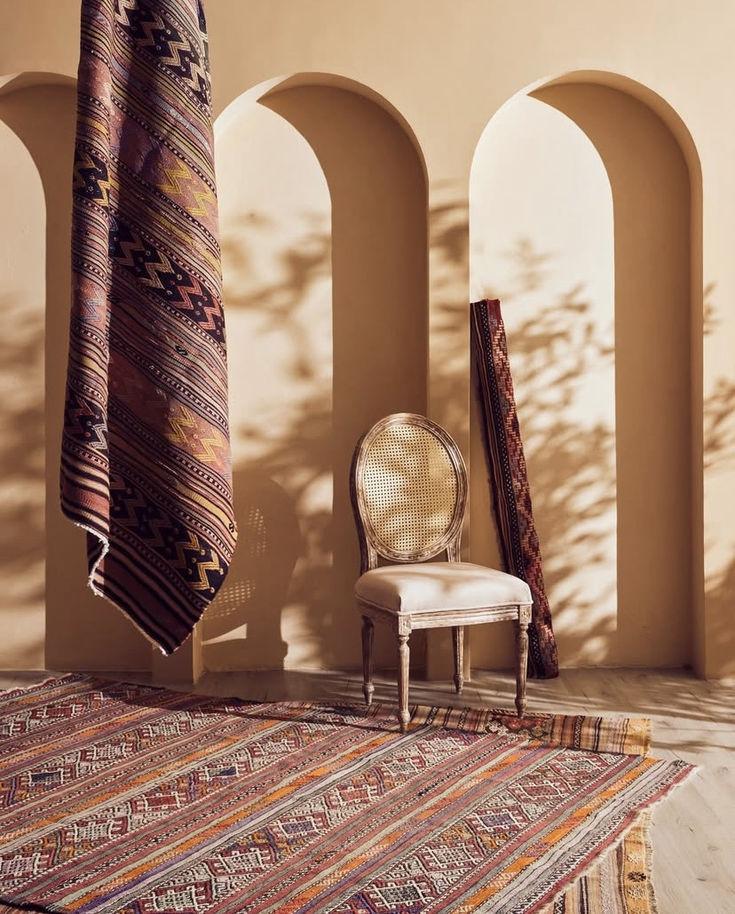
Many kilims are made with a technique called slit tapestry, in which coloured weft threads are woven back and forth within their own area of the design and turn around the neighbouring warp. This leaves tiny gaps, or slits, where one colour block meets another. Slits are a hallmark of the technique and give kilim designs their stepped, angular edges.
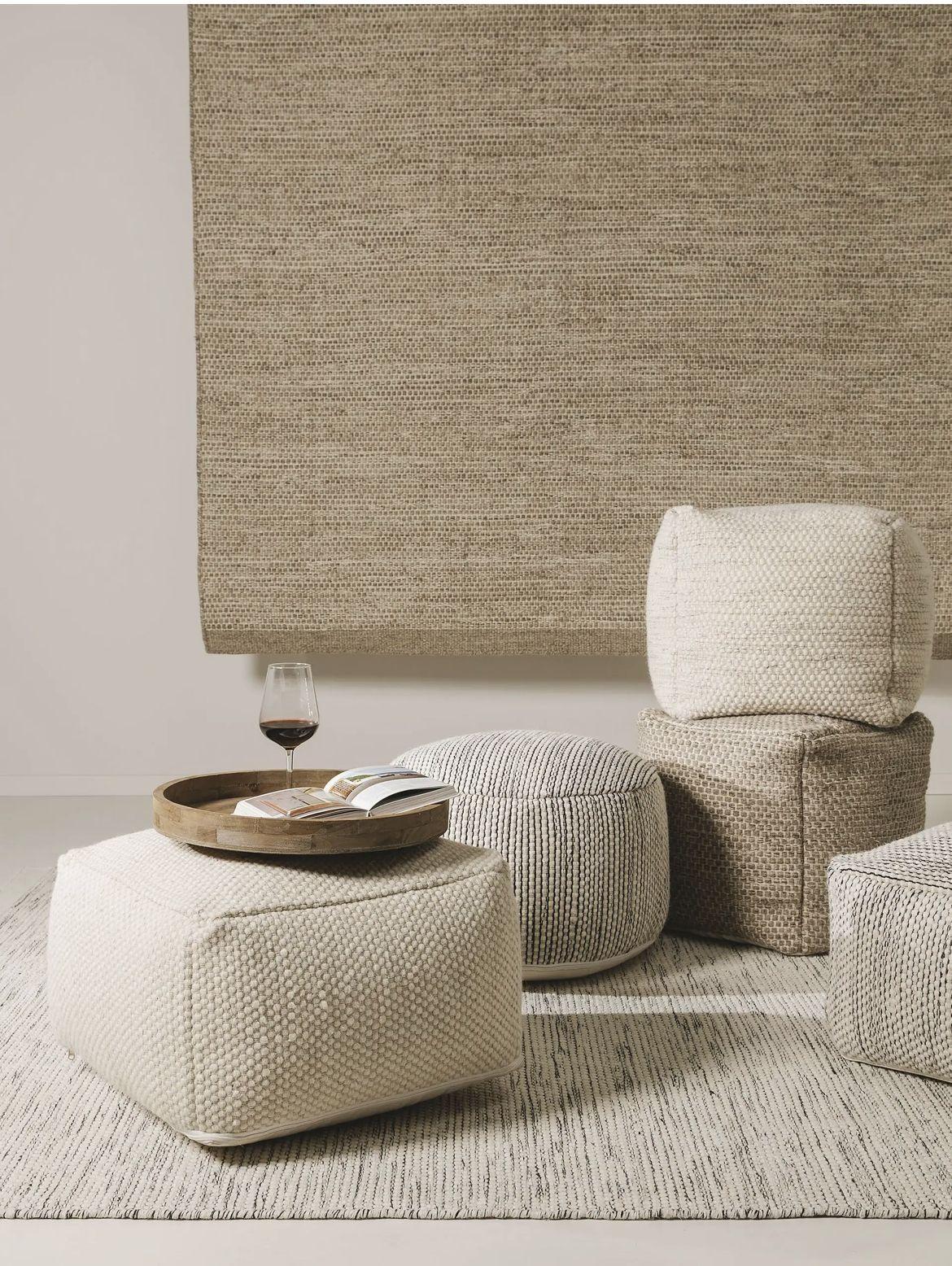
Indian dhurries can be made in more than one way. Some use a plain tapestry weave, some use a weft that runs the full width, and some carry stripes, checks or geometric motifs. Differences can be subtle on the surface, and as a general rule it is the combination of structure, design vocabulary and origin together that tells them apart, not any single feature.
| Factor | Dhurrie | Kilim |
|---|---|---|
| Typical origin | Indian subcontinent | Turkey, Iran, Caucasus, Central Asia, North Africa and others |
| Construction | Flatwoven, no pile | Flatwoven, no pile; often slit tapestry |
| Design language | Stripes, checks, geometric and contemporary pattern | Angular, stepped motifs with regional symbolism |
| Common fibres | Cotton, wool, jute and blends | Wool, sometimes with cotton |
| Reversible | Often | Often |
| Common uses | Floor rugs, runners, layering | Floor rugs, wall hangings, upholstery |
Durability and everyday use
Both are tightly woven flat rugs, and both can be durable if made well. In a flatweave, the weft is what you walk on, so the quality of the yarn and the density of the weave matter more than the name. A firm wool weft that has been beaten down tightly will outlast a loose one in either tradition.
Because neither has pile, neither is as cushioned as a knotted or tufted rug, and both are better under a table, along a hallway or layered over a larger neutral rug than as the main comfort surface in a bedroom. For a comparison with pile, see flatweave vs pile rugs.
Care is straightforward: vacuum without a beater bar, shake out smaller pieces, and have wool flatweaves professionally cleaned when needed. Our care and cleaning page has more.
What buyers and designers should specify
If you are sourcing flatweaves for retail or a project, name the construction and the fibre content on the spec, along with the finished size, the tolerance and the finish. The label dhurrie or kilim is useful for marketing but it does not tell a weaver what to make. Our specification checklist lists the lines to include.
On the supply side, we make flatweaves in India as part of our range, and our weaving page lists flatweave among the constructions we offer. Where a design is inspired by a kilim tradition, we describe it honestly as a contemporary flatweave in that spirit, not as an antique or a piece from another country.
Why the names get mixed up in the market
In retail the two words are often used as style labels, not as technical descriptions. A striped, reversible flatweave from India may be sold as a kilim because the word is better known, and a kilim-inspired design woven elsewhere may be sold as a dhurrie. Neither is necessarily dishonest, but the label tells you little about how the rug was made.
The practical protection is to ask three plain questions: where was it woven, in what fibre, and by what technique. A seller who can answer all three is describing a product, and a seller who can only repeat the name is describing a style. We prefer the former, and our own listings name the construction first.
There is also a difference between new rugs and vintage or antique ones. A vintage kilim is an old object with its own history, wear and value, and it is judged on age, condition and provenance. A new flatweave is judged on construction and finish. Mixing the two standards is a common source of disappointment, and our guide to styling a vintage kilim covers what to expect from an older piece.
Colour, pattern and where each sits in a room
Dhurries often work as a calm, graphic layer: stripes, checks and tonal geometry that sit under furniture without competing with it. Kilims, with their stepped motifs and stronger colour, tend to become a focal point, so they are placed where the eye is meant to land.
Both layer well. A flatweave over a larger neutral rug adds pattern without bulk, and a runner in either tradition suits a corridor or a kitchen. If you plan to hang a flatweave on a wall, check the weight and ask whether the back is finished for hanging, because some constructions are better suited to it than others.
For a retail range, a useful approach is to offer a small number of strong designs in a few colourways rather than many one-offs, and to use samples to confirm each colourway before committing. The sample programme is designed for that.
Verdict by use case
Choose a dhurrie for contemporary interiors, striped and geometric schemes, layering and projects where a lighter, flexible, often cotton-and-wool construction suits the budget and the brief.
Choose a kilim, or a kilim-inspired flatweave, where the design story and the angular motifs are the point, such as in eclectic or collected interiors, and where you want a piece that can double as a wall hanging or upholstery cover.
For either, ask for a sample first. Samples of flatweaves from the sample programme let you check the hand, the weight and the colour before an order. For quantities, use the bulk quote form.
Frequently asked
Is a dhurrie the same as a kilim?
No, though both are flatwoven with no pile. Dhurrie generally refers to flatweaves from the Indian subcontinent, and kilim to flatweaves from Turkey, Iran, the Caucasus, Central Asia and elsewhere. Their design traditions and sometimes their weave structure differ.
Are dhurrie rugs reversible?
Many are, because the pattern is built into the weave and shows on both faces. Check the individual rug, since some constructions have a clearly different back.
Which is more durable, a dhurrie or a kilim?
Neither is inherently more durable. Durability depends on the fibre, the tightness of the weave and the quality of the weft yarn. A tightly woven wool flatweave will outlast a loosely woven one in either tradition.
Can you make flatweave rugs to my own design?
Flatweave is one of the constructions we offer, and we sample designs in more than one weave on request. Send the design, size and quantity through the quote form.
By Raheem & Son Editorial Desk, 15 October 2026
Written with the production and export teams in Bhadohi, where Raheem & Son has made rugs since 1927. See about the house and how we manufacture. Read our editorial policy.
More in Materials and Construction.
Follow the journal in Google Search. Readers who add us as a preferred source see our writing marked in Top Stories and in AI Overviews.