Why a price with no construction attached is meaningless
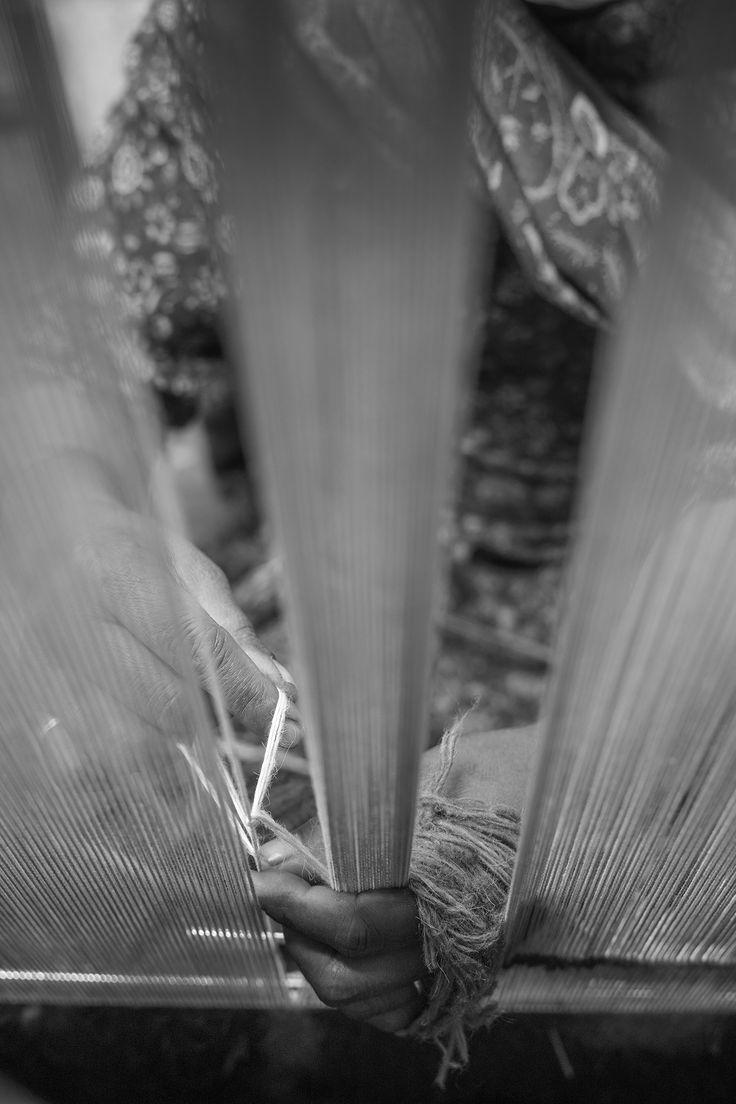
Published ranges for Indian handmade rugs span from the equivalent of a few US dollars per square foot to many tens of dollars, and both ends are accurate. The spread exists because the phrase handmade rug covers products whose labour content differs by an order of magnitude. A hand-tufted rug is made by punching yarn through a stretched canvas with a gun. A hand-knotted rug is made by tying every single knot onto the warp by hand. Comparing their prices is comparing two different industries.
So the first thing to do with any quotation is to check that it states construction, knot or stitch density, fibre, pile height and size. Without those, the number cannot be compared to anything, and a supplier who quotes without them is either guessing or hoping you will not ask.
The seven things that move the number
Construction is the largest single factor, because it sets the labour hours per square foot. Knot or stitch density is next: a rug at 120 knots per square inch carries roughly twice the weaving time of the same design at 60, and the price follows the time. Fibre comes third, where hand-spun and New Zealand wools, mulberry silk, bamboo silk and viscose sit at very different levels.
Then design complexity, which is really a measure of colour changes and curve. A solid or simple geometric field can sit twenty to thirty per cent below the same size in a detailed curvilinear pattern. Then colour count, which affects both dyeing and weaving. Then size and shape: very large pieces need wider looms and more weavers working in coordination, and round or irregular shapes add finishing labour.
Finally, and least visible, volume and repeatability. The same rug costs less per piece in a repeat programme than as a one-off, because sampling, dye-lot setup and loom changeover are amortised. This is why a quotation for one piece and a quotation for a programme of five hundred are not the same quotation.
| Construction | Relative labour | Typically used for | Cost position |
|---|---|---|---|
| Machine-assisted and recycled flatweave | Lowest | Volume retail, value ranges | Entry |
| Hand-woven flatweave and dhurrie | Low to moderate | Graphic, reversible, high traffic | Entry to mid |
| Hand-tufted | Moderate | Fast programmes, hospitality volume | Mid |
| Handloom and loom-knotted | Moderate to high | Textural plains and tonal ranges | Mid to upper |
| Hand-knotted wool | High | Heirloom quality, fine detail | Upper |
| Hand-knotted wool and silk, or pure silk | Highest | Collector and feature pieces | Top |
What the published market ranges look like
Indian suppliers and trade sites that do publish numbers give a broad picture. Rates quoted per square foot across the market run from roughly 35 to 200 Indian rupees for simpler constructions, while a finished 5 by 8 foot hand-knotted merino wool rug is commonly quoted from around 36,000 rupees, or approximately 430 US dollars, at retail-adjacent pricing. Fine silk and high-density knotting move well above that.
Treat every published figure, including those, as a starting orientation rather than a quotation. They rarely state knot density, they mix wholesale and retail, and currency and freight move underneath them. Their real use is to tell you when a quote is wildly out of pattern in either direction, which is the most useful thing a price guide can do.
We do not publish a price list, because every piece we make is woven to order in your size, fibre and colour, and a list would be fiction. What we do commit to is that a quotation from us states construction, density, fibre, size, tolerance, lead time and the Incoterm, so it can be compared line by line with anyone else's.
How to read a quotation like a buyer, not a hopeful
Check the Incoterm first. A price with no Incoterm is not a price. Ex Works, FOB Nhava Sheva and CIF your port are three very different numbers, and the gap between them can exceed the margin you were negotiating over. Our export and logistics page sets out what each one includes.
Then check what is excluded. Sampling, strike-offs, special labelling and packing, non-standard sizes, fire testing and third-party certification are all real costs that belong on the quotation rather than on a later invoice. Ask for them to be listed even when they are zero.
Then check the tolerance and the payment terms in the same breath. A tolerance of plus or minus 3 per cent after washing is normal. Payment terms of a deposit against order and balance against documents are normal. Terms that require full payment before weaving begins are worth questioning, particularly with a supplier you have not used before.
Where buyers lose money without noticing
The first leak is colourways. A range of eight designs in six colours is forty-eight production items, each with its own dye lot, sampling and minimum. Halving the colour count often costs nothing in sales and a great deal less in cash.
The second is air freight bought to rescue a schedule that was always too tight. A hand-knotted programme compressed by four weeks at the start becomes an airway bill at the end, and air freight on rugs is brutal because they are heavy and bulky.
The third is rework at your own warehouse: labels in the wrong place, cartons that cannot go to a customer, barcodes that do not scan. All of it is prevented by a written packing specification agreed before the first production piece, and all of it is expensive to fix after the container has landed.
Frequently asked
How much does a hand-knotted rug from India cost?
It depends almost entirely on knot density, fibre and size, so any single figure is misleading. As orientation, published Indian market pricing for a 5 by 8 foot hand-knotted merino wool rug commonly starts around 36,000 rupees, roughly 430 US dollars, with fine silk and high-density work far above that. For a real number, supply the construction, density, fibre, size and quantity and ask for a quotation stating the Incoterm.
Why is hand-tufted so much cheaper than hand-knotted?
Because the labour content differs by an order of magnitude. A hand-tufted rug is produced by punching yarn through a stretched canvas backing with a tufting gun, which is quick. A hand-knotted rug has every knot tied individually onto the warp, so a single piece can take months. The tufted rug is not a fake, it is a different product with a different lifespan and a different price.
Does a higher knot count always cost more?
Yes, and close to proportionally, because knot count is a direct measure of weaving time. A rug at 120 knots per square inch carries roughly twice the labour of the same design at 60. Whether it is worth paying for depends on the design: fine curvilinear detail needs the density, while a bold geometric pattern usually does not.
What should a rug quotation include?
Construction, knot or stitch density, fibre and blend, pile height, exact size, quantity, dimensional tolerance, lead time from approval, the Incoterm and named port, payment terms, and a list of anything excluded such as sampling, special packing, fire testing or certification. A quotation missing the Incoterm or the tolerance is not yet comparable with any other quotation.
Do prices drop with volume?
Yes, but less dramatically than in machine manufacturing, because most of the cost is human labour that does not compress. What volume genuinely reduces is the per-piece share of sampling, dye-lot setup and loom changeover, which is why a repeat programme in a stable colour range prices better than the same quantity spread across many one-off designs and colourways.
By RS, 10 September 2026
More in Sourcing and Suppliers.
Follow the journal in Google Search. Readers who add us as a preferred source see our writing marked in Top Stories and in AI Overviews.